Remedial Therapy
Remedial Therapy is an individualized educational support approach designed to help children who experience difficulties in learning, academic skills, attention, memory, comprehension or completing school-related tasks.
For children with Autism Spectrum Disorder (ASD), learning disabilities or developmental difficulties, remedial intervention may focus on building foundational academic and functional learning skills according to the child’s individual needs.
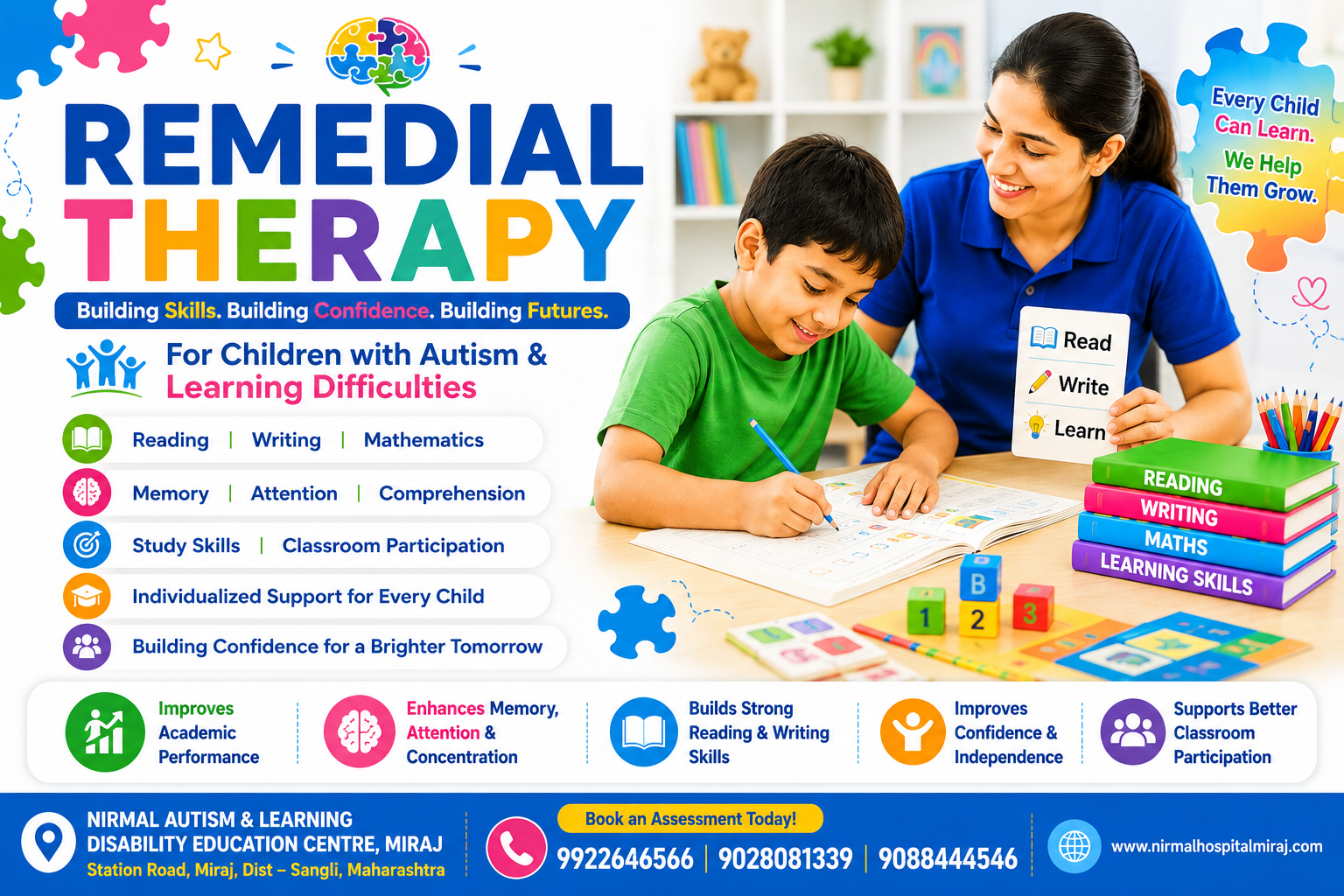
Therapy goals can include reading, writing, mathematics, comprehension, memory, attention, concentration, study skills and classroom participation.
Every child learns differently. Therefore, remedial therapy should be planned according to the child’s strengths, developmental level, learning profile, interests and educational needs.
What is Remedial Therapy?
Remedial Therapy is a structured educational intervention that provides additional support to children who experience difficulties with specific learning or academic skills.
It can help children understand concepts through:
- Individualized teaching
- Repetition and practice
- Visual learning materials
- Activity-based learning
- Step-by-step instruction
- Multisensory learning activities
- Structured routines
- Regular progress monitoring
The aim is to help children develop useful learning skills and participate more confidently in school and everyday educational activities.
Remedial Therapy for Children with Autism
Children with autism may have different learning profiles. Some children may learn academic concepts well but experience difficulties with attention, communication, flexibility, organization or completing tasks.
Others may need additional support with foundational academic skills.
Remedial therapy may support areas such as:
- Reading
- Writing
- Mathematics
- Language comprehension
- Vocabulary
- Memory
- Attention
- Concentration
- Following instructions
- Task completion
- Study habits
- Classroom participation
Educational and developmental supports for autistic children should be individualized and focused on functional participation and meaningful goals.
How Can Remedial Therapy Help Children?
Remedial therapy may help children develop and strengthen specific academic and learning skills.
1. Reading Skills
Children who experience difficulty with reading may receive support with:
- Letter recognition
- Phonics
- Sound-letter association
- Word recognition
- Vocabulary
- Reading fluency
- Reading comprehension
- Sentence reading
- Understanding stories
- Following written instructions
Activities are adapted according to the child’s current reading level.
2. Writing Skills
Remedial therapy may support children who have difficulty with written work.
Areas may include:
- Letter formation
- Word formation
- Spelling
- Sentence writing
- Copying
- Dictation
- Handwriting practice
- Written expression
- Organizing ideas
- Completing written assignments
Where handwriting difficulties are significant, collaboration with an occupational therapist may also be considered.
3. Mathematics Skills
Some children may need additional support to understand mathematical concepts.
Remedial activities may include:
- Number recognition
- Counting
- Number sequencing
- Addition
- Subtraction
- Multiplication
- Division
- Shapes
- Measurement
- Time
- Money concepts
- Word problems
- Basic mathematical reasoning
Visual materials and practical activities can make mathematical concepts easier to understand.
4. Memory Skills
Some children may experience difficulties remembering information, instructions or previously learned concepts.
Remedial activities may support:
- Visual memory
- Auditory memory
- Working memory
- Recall
- Sequencing
- Matching
- Categorization
- Repetition of learned concepts
Memory activities are selected according to the child’s developmental and educational needs.
5. Attention and Concentration
Difficulty maintaining attention can affect classroom learning and task completion.
Remedial sessions may use structured activities to support:
- Sustained attention
- Listening
- Following instructions
- Completing tasks
- Staying engaged
- Shifting between activities
- Reducing distractions
- Maintaining a learning routine
The learning environment can also be structured to reduce distractions and support task completion.
6. Comprehension Skills
Some children may be able to read words but have difficulty understanding their meaning.
Remedial therapy may work on:
- Understanding sentences
- Answering questions
- Identifying main ideas
- Following instructions
- Understanding stories
- Sequencing events
- Vocabulary
- Making connections between concepts
7. Vocabulary and Language-Based Learning
Children may need additional support in understanding and using age-appropriate vocabulary.
Activities may include:
- Naming objects
- Categorizing words
- Understanding concepts
- Describing pictures
- Word association
- Sentence formation
- Following verbal instructions
Speech and language therapy may be recommended alongside remedial intervention when communication or language difficulties are significant.
Remedial Therapy for Learning Difficulties
Remedial therapy may be useful for children who experience difficulties with specific academic skills.
These may include:
- Reading difficulties
- Writing difficulties
- Spelling difficulties
- Mathematical difficulties
- Slow academic progress
- Difficulty understanding concepts
- Difficulty remembering lessons
- Difficulty completing schoolwork
- Attention-related learning difficulties
A proper educational or developmental assessment can help identify the child’s specific learning needs.
Remedial Therapy for Dyslexia, Dysgraphia & Dyscalculia
1. Dyslexia
Children with dyslexia may experience difficulties with reading, decoding, spelling and written language.
Remedial education may provide structured support for reading and language-based academic skills.
2. Dysgraphia
Children with dysgraphia may have difficulty with handwriting, spelling or written expression.
Support may focus on specific writing skills and may be combined with occupational therapy when appropriate.
3. Dyscalculia
Children with dyscalculia may experience difficulties understanding numbers and mathematical concepts.
Remedial teaching may use concrete materials, visual supports and step-by-step mathematical instruction.
Individualized Remedial Therapy Program
Every child has different learning strengths and challenges.
Therefore, the remedial program should be individualized according to:
- Age
- Developmental level
- School grade
- Current academic skills
- Learning profile
- Attention span
- Communication abilities
- Strengths and interests
- Family priorities
- School requirements
AAP guidance emphasizes individualized, measurable goals based on assessment and family input when planning supports for children with autism.
How Does Remedial Therapy Work?
A typical remedial program may follow:
Assessment → Goal Setting → Skill Teaching → Practice → Reinforcement → Progress Monitoring → Review
Step 1 – Assessment
The child’s current academic and learning skills are reviewed.
Step 2 – Identify Learning Needs
Areas requiring additional support are identified.
Step 3 – Set Individual Goals
Specific and meaningful learning goals are established.
Step 4 – Structured Teaching
Concepts are taught using age-appropriate and individualized methods.
Step 5 – Practice
The child receives opportunities to practise the skill repeatedly.
Step 6 – Progress Monitoring
Progress is regularly observed and documented.
Step 7 – Program Review
Teaching strategies and goals can be modified according to the child’s progress.
Teaching Methods Used in Remedial Therapy
Depending on the child’s needs, remedial teaching may include:
1. Multisensory Learning
Children may learn concepts through a combination of:
- Seeing
- Hearing
- Touch
- Movement
- Manipulating learning materials
2.Visual Learning
Visual aids may include:
- Pictures
- Flashcards
- Charts
- Visual schedules
- Number lines
- Story sequences
- Concept maps
3. Step-by-Step Teaching
Complex tasks can be divided into smaller steps to make learning more manageable.
4. Repetition and Practice
Repeated practice can provide opportunities for children to strengthen newly learned academic skills.
5. Activity-Based Learning
Games and practical activities can make learning more engaging and meaningful.
Benefits of Remedial Therapy
Individualized remedial intervention may support:
- Reading skills
- Writing skills
- Mathematical skills
- Vocabulary
- Comprehension
- Memory
- Attention
- Concentration
- Task completion
- Learning confidence
- Classroom participation
- Independent learning
The specific outcomes vary according to the child’s individual needs, goals and response to intervention.
Remedial Therapy and School Support
Remedial therapy can complement the child’s school education.
Depending on the child’s needs, collaboration between:
- Parents
- Remedial educator
- School teachers
- Special educator
- Speech-language therapist
- Occupational therapist
- Behavioural professional
- Other relevant specialists
can help create a more consistent support plan.
AAP guidance emphasizes collaboration among providers and individualized educational supports for children with autism.
Parent Involvement in Remedial Therapy
Parents can play an important role in supporting learning at home.
Parents may be guided to:
- Establish a regular study routine
- Practise reading
- Encourage writing activities
- Use educational games
- Revise concepts regularly
- Provide positive encouragement
- Break homework into smaller tasks
- Reduce unnecessary distractions
- Communicate with teachers and therapists
The goal is to make learning a supportive and positive experience.
Remedial Therapy and Other Autism Therapies
Remedial therapy may be part of a multidisciplinary developmental support program.
Depending on the child’s needs, it may be combined with:
- ABA-based intervention
- Speech & Language Therapy
- Occupational Therapy
- Sensory Integration
- Special Education
- Play Therapy
- Parent Training
- Psychological support
Different interventions can address different areas of a child’s development and learning.
Who May Benefit from Remedial Therapy?
Remedial therapy may be considered for children who experience:
- Autism Spectrum Disorder
- Learning difficulties
- Reading difficulties
- Writing difficulties
- Mathematics difficulties
- Developmental delays
- Difficulty understanding concepts
- Poor academic performance
- Attention and concentration difficulties
- Memory difficulties
- Difficulty completing schoolwork
- Difficulty following academic instructions
A professional assessment can help determine whether remedial intervention is appropriate.
When Should Parents Consider a Remedial Assessment?
Parents may consider an educational assessment if their child:
- Is struggling significantly with schoolwork
- Has difficulty reading age-appropriate text
- Has difficulty writing
- Finds spelling difficult
- Struggles with mathematics
- Takes much longer than expected to complete homework
- Has difficulty remembering learned concepts
- Has difficulty following academic instructions
- Avoids schoolwork frequently
- Has difficulty maintaining attention during learning
- Is progressing more slowly than expected academically
Early identification can help families understand the child’s learning profile and identify appropriate educational support.
Frequently Asked Questions About Remedial Therapy
To connect with us click here
1. What is Remedial Therapy?
Remedial Therapy is individualized educational support designed to help children who experience difficulties with specific learning or academic skills.
2. Can Remedial Therapy help children with Autism?
Yes. Remedial support may help children with autism who experience difficulties with academic learning, attention, comprehension, memory or school participation.
3. Does Remedial Therapy cure Autism?
No. Remedial therapy does not cure autism. It focuses on supporting learning, academic skills, participation and independence.
4. At what age can Remedial Therapy begin?
Remedial support can be considered whenever a child demonstrates learning difficulties. The teaching approach should be adapted to the child’s age and developmental level.
5. Can Remedial Therapy help with reading difficulties?
Yes. Remedial teaching can provide structured support for specific reading skills such as letter-sound association, decoding, vocabulary and reading comprehension.
6. Can Remedial Therapy help with Mathematics?
Yes. Remedial intervention may support children with number concepts, calculations, mathematical reasoning and other foundational mathematics skills.
7. Can Remedial Therapy help a child with Dyslexia?
Remedial educational support may help address specific reading and spelling skills in children with dyslexia. A proper assessment is important to identify the child’s individual learning needs.
8. Can Remedial Therapy be combined with Occupational Therapy?
Yes. When a child has both academic and motor or functional difficulties, remedial education and occupational therapy may be included as complementary parts of an individualized support plan.
9. How long does Remedial Therapy take?
There is no fixed duration. Frequency and duration depend on the child’s learning needs, goals, progress and response to intervention.
10. Is parent involvement important?
Yes. Parents can support children by practising skills at home, maintaining routines and communicating regularly with teachers and therapists.
Remedial Therapy at Nirmal Autism & Learning Disability Education Centre, Miraj
At Nirmal Autism & Learning Disability Education Centre, Miraj, remedial programs are planned according to each child’s individual educational and developmental needs.
Our remedial support may focus on:
- Reading
- Writing
- Mathematics
- Vocabulary
- Comprehension
- Memory
- Attention
- Concentration
- Study skills
- Task completion
- Academic participation
The program can be coordinated with other developmental interventions when appropriate.
Our focus is on helping children build useful learning skills, confidence and greater participation in school and everyday educational activities.
Give Your Child the Right Learning Support
Every child has a unique learning profile.
With appropriate assessment, individualized goals and consistent support, children can be given opportunities to strengthen academic and functional learning skills.
If your child is experiencing difficulties with reading, writing, mathematics, memory, attention, comprehension or schoolwork, consider a professional learning assessment.