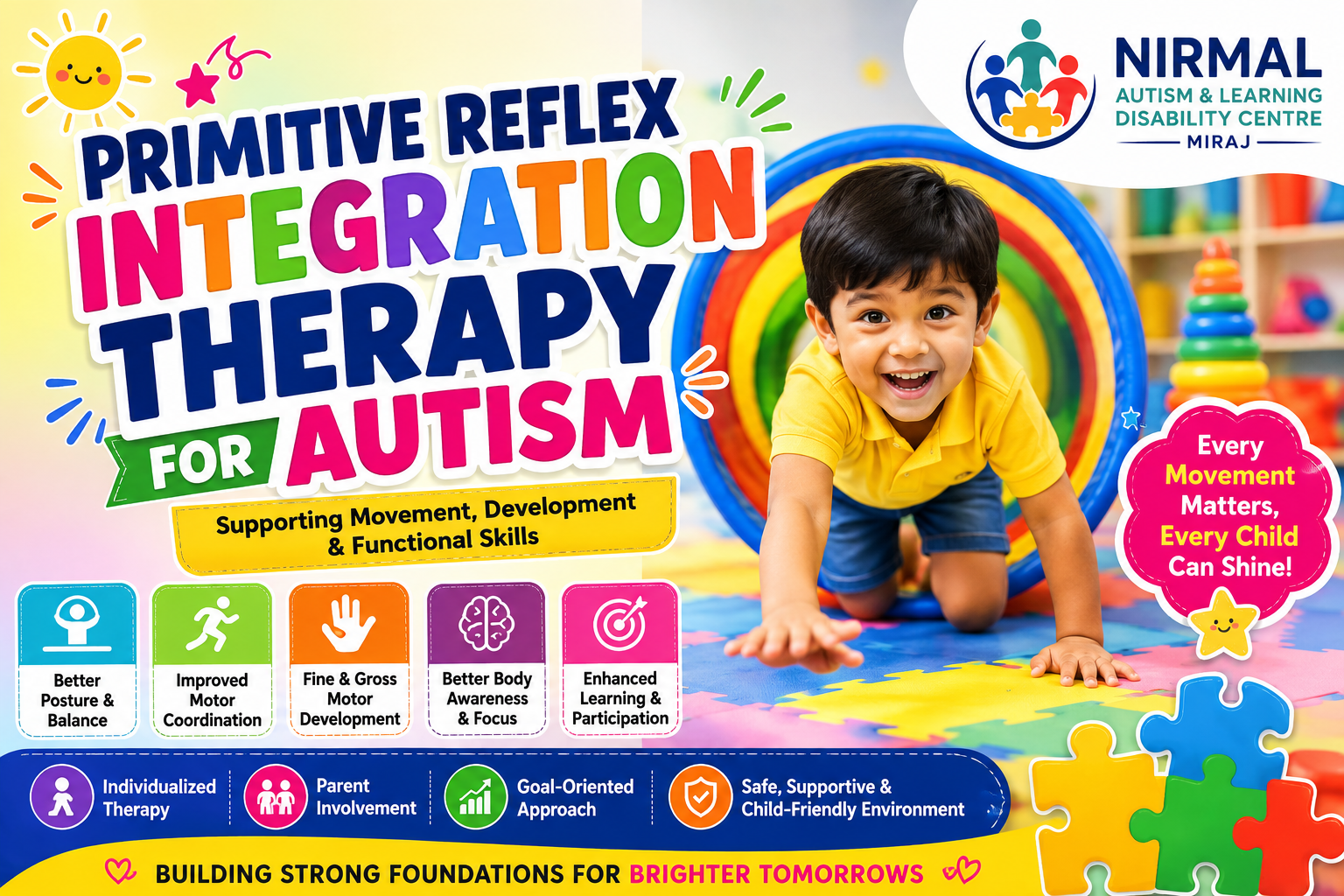
Primitive Reflex Integration Therapy for Autism | Nirmal Autism & Learning Disability Centre
Learn how Primitive Reflex Integration Therapy may support motor coordination, posture, balance and functional skills in children with autism. Individualized therapy at Nirmal Autism & Learning Disability Centre, Miraj.
Primitive Reflex Integration Therapy is an individualized developmental approach that may be included in a child’s therapy plan when assessment identifies motor, postural, coordination or functional difficulties. At Nirmal Autism & Learning Disability Centre, therapy is planned according to each child’s specific developmental needs and functional goals.
Primitive Reflex Integration Therapy for Autism
Primitive Reflex Integration Therapy is a developmental approach that focuses on movement patterns associated with primitive reflexes and their relationship to posture, balance, coordination and functional activities.
Primitive reflexes are automatic movement responses that appear during early development and typically become integrated as the child’s nervous system matures. When a child demonstrates persistent reflex-related movement patterns along with functional difficulties, a trained professional may consider appropriate movement-based activities as part of an individualized therapy plan.
For children with autism, therapy should be based on a comprehensive assessment and focused on meaningful functional goals such as participation, motor performance, self-care, learning and everyday activities.
What Are Primitive Reflexes?
Primitive reflexes are automatic responses that are present during early infancy. They play an important role in early neurological and motor development.
As the child’s nervous system develops, many of these reflexes gradually become less dominant and are replaced by more voluntary and controlled movements.
Examples of commonly discussed primitive reflexes include:
1. Moro Reflex
The Moro reflex is an early infant response associated with sudden changes in movement or sensory stimulation. Persistent reflex-related responses may be considered during a developmental assessment when they appear to affect functional activities.
2. Asymmetrical Tonic Neck Reflex (ATNR)
The ATNR is associated with head and limb movement patterns during early development. Assessment may consider its relationship with bilateral coordination, hand use and movement control.
3. Symmetrical Tonic Neck Reflex (STNR)
The STNR is associated with the development of coordinated movements between the upper and lower parts of the body. It may be considered when assessing posture, crawling patterns and other movement-related activities.
4. Tonic Labyrinthine Reflex (TLR)
The TLR is associated with body position, movement and postural control. A therapist may assess related movement patterns when a child demonstrates difficulties with balance or body control.
5. Spinal Galant Reflex
The Spinal Galant reflex is an early developmental reflex associated with movement responses around the trunk. Its presence or persistence should be interpreted within a broader developmental and functional assessment.
Primitive Reflexes and Autism
Autism Spectrum Disorder (ASD) is a neurodevelopmental condition with differences in communication, social interaction, behavior, sensory processing and development.
Some autistic children may also experience motor coordination, postural control, balance, sensory processing or praxis-related difficulties. However, the presence of a primitive reflex by itself does not establish autism, nor does it necessarily mean that a child has a functional impairment.
Therefore, reflex-related observations should be interpreted as part of a comprehensive assessment rather than used as a standalone diagnostic measure.
How Can Primitive Reflex Integration Therapy Support a Child?
When clinically appropriate, movement-based activities may be incorporated into a broader therapy program to address specific functional goals.
Depending on the child’s assessment, therapy may focus on:
1. Postural Control
Activities may be selected to support body alignment, stability and control during sitting, standing and movement.
2. Balance and Coordination
Movement activities can be designed to encourage balance, bilateral coordination and controlled body movements.
3. Gross Motor Skills
Therapy may include age-appropriate activities involving crawling, climbing, reaching, jumping, pushing, pulling and other gross motor movements.
4. Fine Motor Readiness
Improved postural stability and coordinated body movements may support participation in activities requiring hand control and visual-motor coordination.
5. Bilateral Coordination
Activities may encourage the coordinated use of both sides of the body during play, dressing, writing and other daily activities.
6. Body Awareness
Movement-based activities may help children develop awareness of body position and movement during functional tasks.
7. Functional Participation
The primary goal should be meaningful improvement in the child’s participation in everyday activities rather than simply attempting to change reflex status.
Who May Benefit From This Therapy?
Primitive Reflex Integration Therapy may be considered for children who demonstrate specific functional difficulties identified during professional assessment.
It may be considered when a child has difficulties such as:
- Poor postural control
- Difficulty maintaining sitting posture
- Balance difficulties
- Bilateral coordination challenges
- Gross motor delays
- Difficulty with body awareness
- Motor planning difficulties
- Difficulty coordinating movements
- Challenges with functional play
- Difficulties participating in age-appropriate activities
Not every child with autism needs reflex integration activities. The therapy plan should be individualized according to the child’s strengths, challenges and functional goals.
Primitive Reflex Integration Therapy Assessment
A comprehensive assessment helps determine whether movement-based intervention is appropriate for a child.
The therapist may consider:
1. Developmental History
Information about early motor milestones, movement patterns, communication, play and daily functioning may be reviewed.
2. Motor Skills
Gross motor, fine motor, coordination, balance and postural control may be assessed.
3. Functional Skills
The therapist may evaluate how movement difficulties affect activities such as:
- Sitting
- Walking
- Dressing
- Feeding
- Playing
- Writing
- School activities
- Self-care
4. Sensory and Motor Processing
Relevant sensory and motor characteristics may be considered when planning an individualized intervention program.
5. Functional Goals
Therapy goals should be measurable and connected to meaningful activities in the child’s daily life.
What Happens During Primitive Reflex Integration Therapy?
Therapy activities are selected according to the child’s developmental level, tolerance and functional goals.
A session may include age-appropriate movement activities such as:
- Crawling patterns
- Cross-body movements
- Balance activities
- Core and postural control activities
- Bilateral coordination exercises
- Reaching and weight-shifting activities
- Motor planning games
- Gross motor play
- Functional movement activities
Activities should be supervised by an appropriately trained professional and modified according to the child’s individual needs.
Primitive Reflex Integration Therapy and Occupational Therapy
Occupational therapy focuses on helping children participate more successfully in meaningful everyday activities.
When reflex-related movement patterns are considered during occupational therapy, the intervention should be connected to functional outcomes rather than focusing only on whether a reflex is present or absent.
For example, therapy may connect movement activities with goals such as improved sitting, dressing, handwriting readiness, play, self-care or participation in school activities.
The American Occupational Therapy Association recommends connecting reflex-integration approaches with occupational performance and functional outcomes rather than using reflex integration as an isolated goal.
Primitive Reflex Integration vs. Sensory Integration Therapy
Primitive Reflex Integration Therapy and sensory integration approaches are not the same intervention.
Primitive reflex approaches focus on movement patterns associated with early developmental reflexes, whereas sensory integration approaches address how the nervous system processes and responds to sensory information.
Some children may receive movement-based activities alongside occupational therapy, sensory-based interventions, or other developmental therapies depending on their individual assessment.
Evidence for sensory integration approaches is evolving. Recent research has reported benefits for some motor and functional outcomes, while evidence varies by intervention and population.
Is Primitive Reflex Integration a Treatment for Autism?
Primitive Reflex Integration Therapy should not be described as a cure for autism.
Autism is a neurodevelopmental condition, and there is no single therapy that is appropriate for every autistic child.
The purpose of a movement-based or reflex-related intervention should be to address identified functional difficulties and support the child’s participation in everyday activities.
A child’s therapy program may include several approaches depending on their individual needs, such as occupational therapy, speech and language therapy, behavioral or developmental interventions, special education and other appropriate services.
How Often Is Primitive Reflex Integration Therapy Needed?
The frequency and duration of therapy depend on the child’s assessment, age, functional difficulties, goals and response to intervention.
There is no single schedule that is appropriate for every child.
A qualified therapist can develop an individualized therapy plan and review progress regularly.
Benefits of an Individualized Therapy Approach
Every child has different strengths and developmental needs.
An individualized approach can help therapists:
- Identify the child’s specific functional difficulties
- Set realistic and measurable goals
- Select appropriate activities
- Adjust activities according to the child’s response
- Track functional progress
- Involve parents and caregivers
- Connect therapy with everyday activities
The focus should remain on helping the child participate more effectively in home, school and community activities.
Parent and Caregiver Involvement
Parents and caregivers play an important role in supporting developmental progress.
Therapists may guide parents on appropriate activities that can be incorporated into daily routines when clinically suitable.
Parents should avoid independently performing complex reflex exercises without professional guidance, particularly when the child has significant developmental, motor or medical concerns.
Why Choose Nirmal Autism & Learning Disability Centre, Miraj?
At Nirmal Autism & Learning Disability Centre, Miraj, therapy is planned according to the individual needs and functional goals of the child.
Our multidisciplinary developmental services may include:
1. Occupational Therapy
Activities focused on functional skills, motor development, sensory-motor abilities and participation.
2. Sensory Integration Therapy
Individualized sensory-motor activities based on the child’s assessment and functional needs.
3. ABA Therapy
Structured behavioral and developmental support based on individualized goals.
4. Remedial Therapy
Support for learning, academic and developmental difficulties.
5. Special Education
Individualized educational support according to the child’s learning profile.
6. Parent Guidance
Parents and caregivers can receive guidance on supporting their child’s developmental and functional goals at home.
Note: If you want to know about Intellactual Disability Information Click here
When Should Parents Seek a Professional Assessment?
Parents may consider a professional developmental assessment if their child demonstrates persistent difficulties with:
- Motor development
- Balance
- Coordination
- Posture
- Movement planning
- Self-care skills
- Play skills
- Learning
- Communication
- Sensory processing
- Everyday functional activities
Early assessment can help identify the child’s strengths and areas where additional support may be useful.
Frequently Asked Questions About Primitive Reflex Integration Therapy
1. What is Primitive Reflex Integration Therapy?
Primitive Reflex Integration Therapy refers to movement-based approaches that focus on movement patterns associated with primitive reflexes. When used clinically, activities should be linked to the child’s specific functional needs and goals.
2. Is Primitive Reflex Integration Therapy suitable for every autistic child?
No. Every autistic child has different strengths and challenges. A professional assessment should determine whether this approach is appropriate and what functional goals should be addressed.
3. Can Primitive Reflex Integration Therapy cure autism?
No. Primitive Reflex Integration Therapy is not a cure for autism. It may be considered as one component of a broader individualized therapy program when specific functional difficulties are identified.
4. Can reflex integration improve motor skills?
Movement-based therapy may be used to work on specific motor and functional skills. However, outcomes vary between children, and therapy should be guided by assessment and measurable goals.
5. Is Primitive Reflex Integration the same as Sensory Integration Therapy?
No. They are different approaches. Sensory integration approaches focus on processing and responding to sensory information, while reflex-related approaches focus on movement patterns associated with developmental reflexes.
6. How long does Primitive Reflex Integration Therapy take?
There is no standard duration. Therapy frequency and duration depend on the child’s individual assessment, goals and progress.
7. Can parents do reflex exercises at home?
Parents may be given appropriate home activities by a qualified therapist. It is better to follow individualized professional guidance rather than using generalized exercise programs without assessment.
8. What age is appropriate for this therapy?
There is no single age at which this approach is appropriate for every child. Suitability depends on the child’s developmental profile, functional difficulties and therapy goals.
Take the Next Step for Your Child’s Development
If your child is experiencing difficulties with posture, balance, coordination, motor planning, sensory-motor skills or everyday activities, a professional developmental assessment can help identify the appropriate support.
At Nirmal Autism & Learning Disability Centre, Miraj, therapy is planned around the child’s individual strengths, needs and functional goals.
If you want to know about Child Psychiatry- लहान मुलांमधील Mobile Addiction | कारणे व उपाय #deaddictioncentre Click here