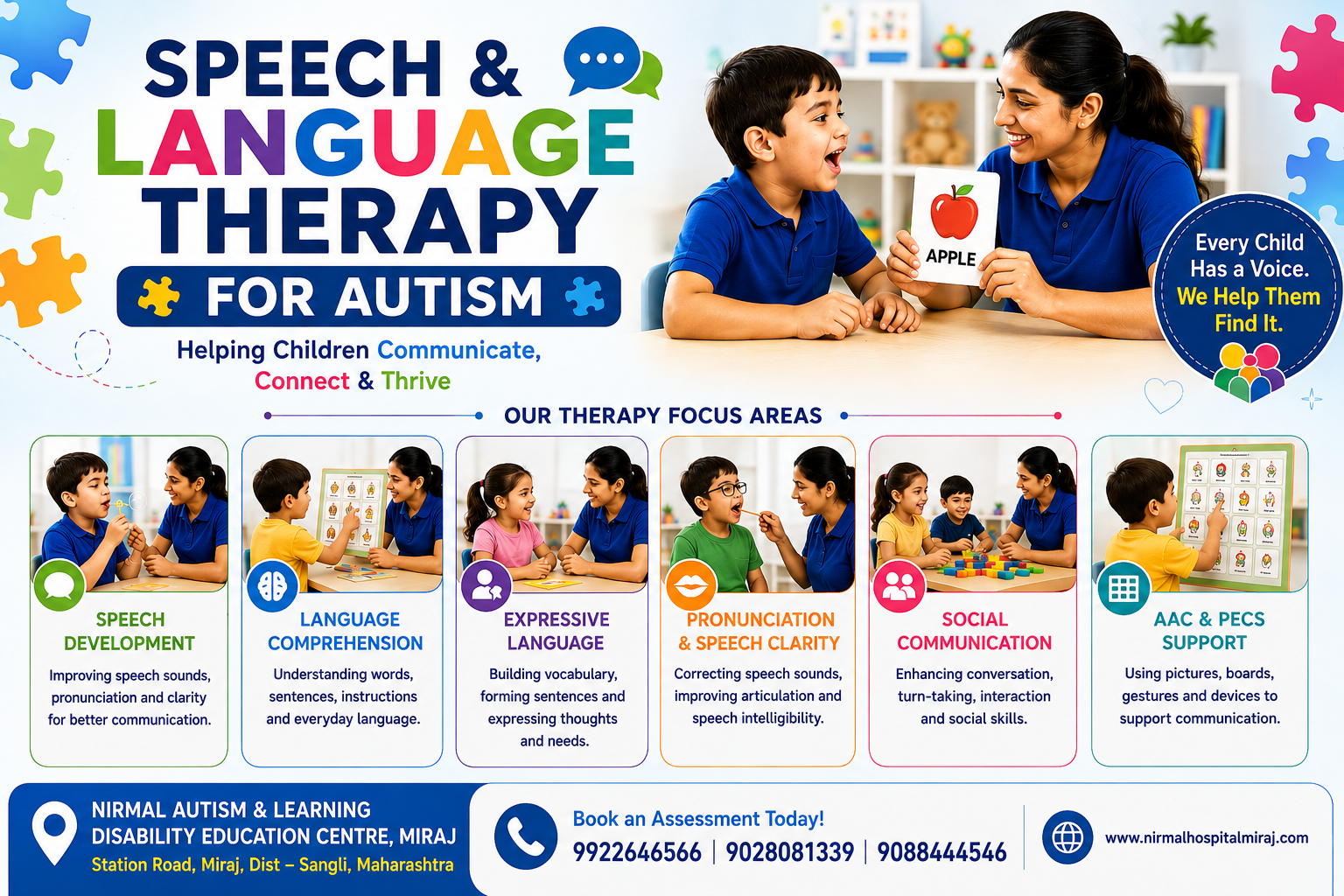
Speech & Language Therapy helps children develop communication skills needed to express their needs, understand others and participate more effectively in everyday life.
For children with Autism Spectrum Disorder (ASD) and developmental communication difficulties, speech and language therapy may focus on areas such as speech development, language comprehension, functional communication, social communication, pronunciation, alternative communication and interaction skills.
Every child communicates differently. Therefore, therapy goals are individualized according to the child’s age, developmental level, communication abilities, strengths and needs.
What is Speech & Language Therapy?
Speech and Language Therapy is a specialized intervention that supports children who have difficulties with:
- Speech development
- Understanding language
- Expressing themselves
- Pronunciation
- Social communication
- Conversation
- Functional communication
- Alternative and Augmentative Communication (AAC)
A speech-language therapist assesses the child’s communication abilities and develops an individualized intervention plan.
Speech & Language Therapy for Autism
Children with autism may experience differences in communication and social interaction.
Some children may:
- Start speaking later than expected
- Have difficulty expressing their needs
- Use fewer words than expected for their age
- Repeat words or phrases
- Have difficulty answering questions
- Find it difficult to start or maintain conversations
- Have difficulty understanding instructions
- Struggle with social communication
- Prefer gestures or non-verbal communication
- Have difficulty using communication appropriately in different situations
Speech and language therapy can support functional communication and help children participate more effectively in everyday activities.
How Can Speech Therapy Help Children with Autism?
Speech and language therapy may address several areas of communication.
1. Speech Development
Therapy may help children who have difficulty developing spoken communication.
Activities may focus on:
- Sound production
- Word development
- Vocabulary
- Combining words
- Sentence development
- Functional speech
- Clearer communication
The goals depend on the child’s current communication level.
2. Language Comprehension
Some children may understand fewer words or instructions than expected for their age.
Therapy may support understanding of:
- Names of people and objects
- Simple instructions
- Questions
- Concepts
- Actions
- Descriptions
- Everyday routines
- More complex language as the child progresses
Improved language comprehension can help children participate in home, school and therapy activities.
3. Expressive Language
Expressive language refers to how a child communicates thoughts, needs, feelings and ideas.
A speech-language therapist may work on:
- Naming objects
- Requesting items
- Answering questions
- Describing activities
- Expressing choices
- Using sentences
- Telling simple stories
- Communicating feelings
- Initiating communication
The emphasis should be on functional and meaningful communication.
4. Pronunciation and Speech Clarity
Some children may know what they want to say but have difficulty producing speech sounds clearly.
Speech therapy may address:
- Speech sound production
- Articulation
- Intelligibility
- Sound patterns
- Oral-motor coordination when clinically indicated
- Clearer production of words
The therapist selects activities based on the child’s speech assessment.
5. Social Communication Skills
Social communication involves using communication appropriately with other people.
Therapy may support skills such as:
- Greeting others
- Initiating interaction
- Responding to others
- Taking turns
- Maintaining a conversation
- Asking for help
- Sharing information
- Understanding conversational routines
- Participating in group activities
Social communication goals should be meaningful and relevant to the child’s everyday life.
Communication Skills for Non-Verbal or Minimally Speaking Children
Not every child with autism communicates primarily through spoken language.
Some children may communicate using:
- Gestures
- Facial expressions
- Pictures
- Communication boards
- Visual supports
- Sign-based communication
- AAC systems
- PECS
What is PECS?
PECS (Picture Exchange Communication System) is a structured picture-based communication approach that can help some children communicate requests and other messages.
The speech-language therapist can determine whether PECS or another Augmentative and Alternative Communication (AAC) approach may be appropriate for the child.
AAC should be viewed as a way to support communication, not as a failure to develop speech.
Augmentative and Alternative Communication (AAC)
AAC refers to communication methods used in addition to, or instead of, spoken language.
AAC can include:
- Gestures
- Sign language
- Picture communication
- Communication boards
- PECS
- Visual supports
- Speech-generating devices
- Tablet-based communication systems
The appropriate communication method depends on the child’s abilities, preferences and communication goals.
1. Speech & Language Assessment
Before beginning therapy, a speech-language therapist may assess:
- Receptive language
- Expressive language
- Speech sounds
- Vocabulary
- Sentence development
- Functional communication
- Social communication
- Play and interaction
- Understanding of instructions
- Non-verbal communication
- AAC needs where appropriate
Assessment findings help establish individualized therapy goals.
2. Individualized Speech Therapy Program
Every child has a unique communication profile.
Therefore, therapy goals may be based on:
- Age
- Developmental level
- Current communication abilities
- Speech and language needs
- Learning style
- Interests
- Family priorities
- School requirements
- Everyday communication needs
Examples of Individualized Goals
A child’s goals may include:
- Requesting preferred items
- Following two-step instructions
- Increasing functional vocabulary
- Answering simple questions
- Using short sentences
- Improving speech clarity
- Initiating interaction
- Taking conversational turns
- Using pictures or AAC
- Communicating choices
- Expressing emotions
- Participating in classroom activities
3. Speech Therapy Through Play
Children often learn communication skills more naturally when activities are engaging and meaningful.
Speech-language therapy may use:
- Toys
- Picture cards
- Storybooks
- Puzzles
- Songs
- Rhymes
- Pretend play
- Matching activities
- Turn-taking games
- Interactive games
- Everyday routines
Play-based activities can provide opportunities for children to practise communication in motivating situations.
4. Speech Therapy for Social Interaction
For children who have difficulty interacting with others, therapy may incorporate activities that encourage:
- Eye gaze when comfortable and meaningful
- Joint attention
- Turn-taking
- Requesting
- Responding
- Initiating interaction
- Sharing interests
- Conversational skills
- Group participation
The focus should be on meaningful social connection and communication rather than forcing a child to behave in a particular way.
5. Parent Involvement in Speech Therapy
Parents and caregivers are important partners in a child’s communication development.
Parents may be guided to:
- Create communication opportunities at home
- Encourage the child to make choices
- Use simple and clear language
- Wait for the child to respond
- Follow the child’s interests
- Model useful words and phrases
- Use visual supports when appropriate
- Practise communication during daily routines
Communication practice can happen during:
- Mealtimes
- Bathing
- Dressing
- Shopping
- Playing
- Reading
- Travelling
- School preparation
Speech & Language Therapy and Other Autism Therapies
Speech and language therapy can be part of a multidisciplinary autism intervention program.
Depending on the child’s needs, it may be combined with:
- ABA-based intervention
- Occupational Therapy
- Sensory Integration
- Special Education
- Remedial Therapy
- Play Therapy
- Parent Training
- Psychological support
Different therapies can address different aspects of the child’s development.
Benefits of Speech & Language Therapy
Individualized speech and language intervention may support:
- Functional communication
- Understanding of language
- Expressive language
- Speech clarity
- Vocabulary development
- Sentence formation
- Social communication
- Conversation skills
- Requesting and making choices
- Participation in everyday activities
- Use of AAC when appropriate
The specific benefits and progress vary from child to child.
Who May Benefit from Speech & Language Therapy?
Speech and language assessment may be useful for children experiencing:
- Speech delay
- Language delay
- Autism Spectrum Disorder
- Unclear speech
- Difficulty understanding instructions
- Limited vocabulary
- Difficulty forming sentences
- Difficulty communicating needs
- Social communication difficulties
- Repetitive speech
- Difficulty participating in conversations
- Non-verbal or minimally speaking communication needs
- Difficulty using communication appropriately in everyday situations
When Should Parents Seek a Speech & Language Assessment?
Parents may consider professional assessment if their child:
- Is not using age-expected communication skills
- Has difficulty expressing needs
- Does not consistently respond to communication
- Has difficulty understanding instructions
- Uses very few words
- Repeats words or phrases frequently
- Has difficulty interacting with other children
- Is difficult to understand when speaking
- Relies heavily on gestures without developing functional communication
- Has difficulty participating in conversations
A professional assessment can help identify the child’s communication strengths and areas requiring support.
Frequently Asked Questions About Speech & Language Therapy
1. What is Speech & Language Therapy?
Speech and Language Therapy supports children with difficulties related to speech, language, communication and social interaction.
2. Can Speech Therapy help children with Autism?
Yes. Speech-language therapy can support communication and social-communication skills in children with autism, based on their individual needs.
3. Does Speech Therapy cure Autism?
No. Speech therapy does not cure autism. It focuses on developing functional communication, language, speech and social participation.
4. At what age should a child start Speech Therapy?
A child can be assessed whenever communication concerns are noticed. Therapy goals are adapted according to the child’s age and developmental level.
5. Can Speech Therapy help a non-verbal child?
Speech therapy can support functional communication in children who are non-speaking or minimally speaking. Depending on the child’s needs, AAC, pictures, gestures, PECS or other communication methods may be considered.
6. Will using AAC or PECS stop a child from speaking?
AAC is intended to support communication. For some children, AAC can provide a reliable way to communicate while spoken language development is also supported when appropriate.
7. How long does Speech Therapy take?
The duration and frequency of therapy vary depending on the child’s communication needs, goals, response to intervention and progress.
8. Can parents participate in Speech Therapy?
Yes. Parent participation can provide children with additional opportunities to practise communication skills in everyday situations.
Therapy may focus on:
- Speech Development
- Language Comprehension
- Expressive Language
- Pronunciation
- Functional Communication
- Social Communication
- Non-Verbal Communication
- AAC
- PECS
- Play and Interaction Skills
- Parent Guidance
Our child-centred approach focuses on helping children communicate their needs, choices, ideas and feelings and participate more effectively at home, school and in the community.
If you want to know about Autism Click Here
Give Your Child the Opportunity to Communicate
Every child has a unique way of learning and communicating.
Early identification of communication difficulties and individualized intervention can help families understand their child’s communication needs and choose appropriate support.
If you have concerns about your child’s speech, language, communication or social interaction, consider a professional speech and language assessment.
Take a look on Speech & Language therapy related video click here