Phonemic Intelligence Therapy for Autism | Nirmal Autism Centre Miraj
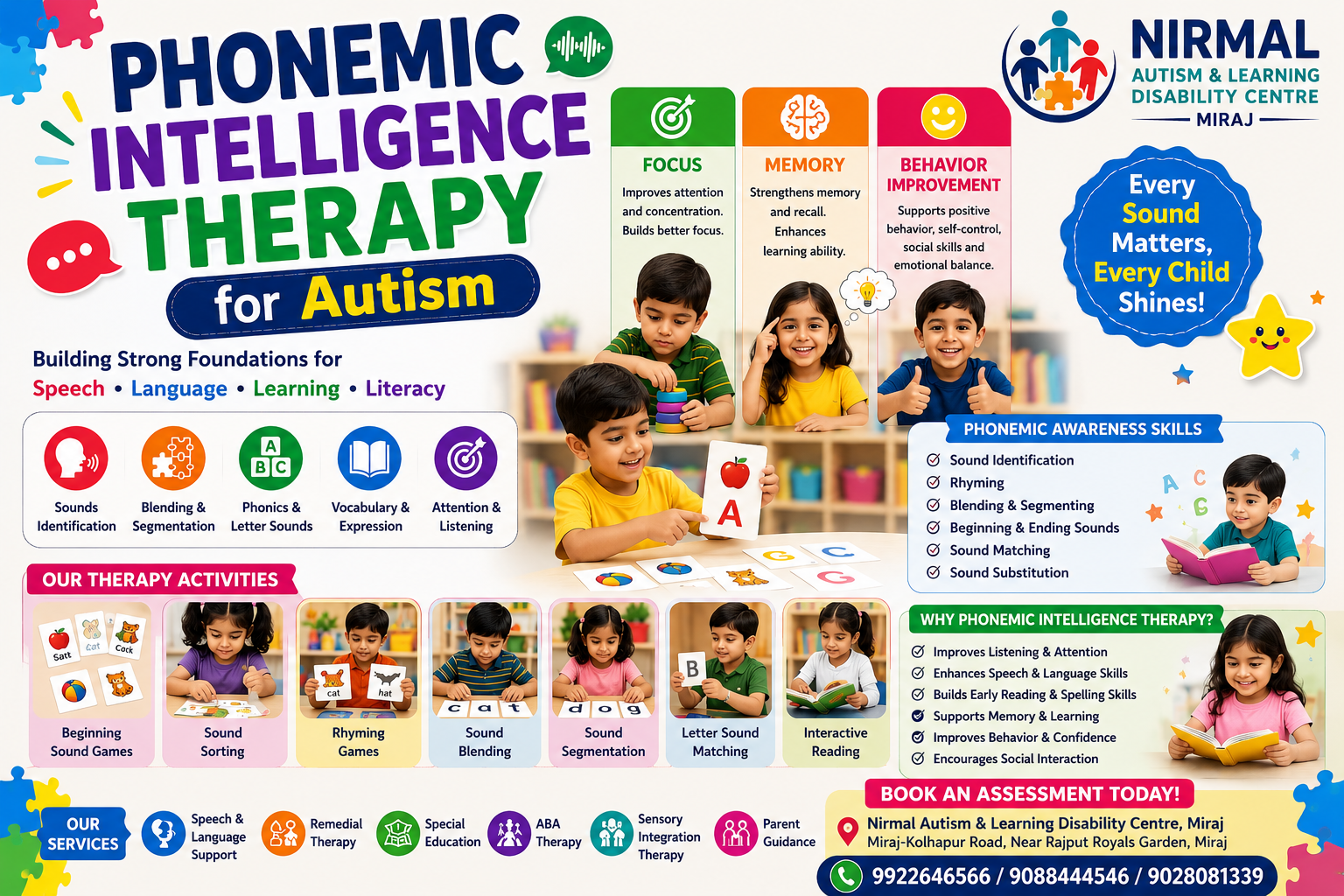
Phonemic Intelligence Therapy for autism focuses on speech sounds, phonemic awareness, listening, language and early literacy skills through individualized activities at Nirmal Autism Centre, Miraj.
Phonemic Intelligence Therapy supports children’s awareness of speech sounds, phonological skills, language development and early literacy through structured, child-friendly activities tailored to individual needs.
Phonemic Intelligence Therapy for Autism
Phonemic Intelligence Therapy is a structured, child-friendly approach that focuses on helping children develop awareness of speech sounds, words, syllables and sound patterns.
For children with autism, differences in communication, language development and early literacy skills can sometimes affect participation in learning activities. Individualized phonemic-awareness and language activities may help children build important foundations for reading, spelling and communication.
At Nirmal Autism & Learning Disability Centre, Miraj, activities are planned according to the child’s developmental level, communication abilities, learning profile and individual goals.
What Is Phonemic Intelligence Therapy?
Phonemic Intelligence Therapy focuses on helping children notice, recognize and work with the individual sounds that make up spoken words.
The term phonemic awareness refers to the ability to identify and manipulate individual sounds, or phonemes, in spoken language.
Children may gradually learn skills such as:
- Listening carefully to speech sounds
- Identifying beginning sounds
- Identifying ending sounds
- Matching similar sounds
- Recognizing rhyming words
- Blending sounds to make words
- Breaking words into individual sounds
- Counting sounds in words
- Changing sounds to create new words
These skills are important foundations for learning to read and spell.
Research on children with autism has examined reading interventions involving phonemic awareness, phonics, fluency, vocabulary and comprehension. A systematic review and meta-analysis found improvements in phonological awareness following some reading interventions, although the authors noted that the certainty of evidence was limited and further research is needed.
What Are Phonemic Awareness Skills?
Phonemic awareness is an important part of early literacy development.
1. Sound Identification
The child learns to listen for specific sounds in spoken words.
Example: “What sound do you hear at the beginning of sun?”
Answer: /s/
2. Sound Matching
Children learn to identify words that begin or end with the same sound.
Example: “Do sun and sock start with the same sound?”
3. Sound Blending
The child learns to combine individual sounds to form a complete word.
Example: /c/ + /a/ + /t/ → cat
4. Sound Segmentation
The child learns to break a word into individual sounds.
Example: dog → /d/ /o/ /g/
5. Sound Substitution
The child learns that changing one sound can create a different word.
Example: Change /m/ in mat to /s/.
sat
6. Rhyming
The child learns to recognize words with similar ending sounds.
Example: cat – bat – hat
Why Are Phonemic Awareness Skills Important?
Phonemic awareness is closely connected with the development of early reading skills.
Children need to understand that spoken words are made up of smaller sound units before they can effectively connect sounds with written letters.
Evidence-based reading instruction commonly includes:
- Phonemic awareness
- Phonics
- Reading fluency
- Vocabulary
- Reading comprehension
Research specifically examining reading instruction in children with autism indicates that learners can benefit from instruction based on established reading principles, although the evidence base remains developing.
Phonemic Intelligence Therapy and Autism
Autistic children have highly individual communication and learning profiles.
Some children may demonstrate difficulties with:
- Speech-sound awareness
- Listening skills
- Vocabulary development
- Following verbal instructions
- Sound discrimination
- Early reading skills
- Letter-sound associations
- Word decoding
- Rhyming
- Sound blending
- Sound segmentation
However, not every autistic child will have the same difficulties.
Therefore, phonemic-awareness activities should be selected according to the child’s individual assessment rather than using the same program for every child.
How Phonemic Intelligence Therapy May Support Children
When appropriately planned, phonemic-awareness and literacy activities may support several areas of learning.
1. Speech Sound Awareness
Children can learn to pay attention to individual sounds within spoken words.
2. Listening Skills
Structured listening games can encourage children to attend to differences between sounds and words.
3. Vocabulary Development
Sound and word activities can be combined with age-appropriate vocabulary-building exercises.
4. Early Reading Skills
Phonemic awareness can provide an important foundation for learning how spoken sounds relate to written language.
5. Phonics Skills
Children can gradually learn relationships between letters and their corresponding sounds.
6. Spelling Readiness
Understanding the sound structure of words can support early spelling development.
7. Language and Learning
Sound-based activities can be incorporated into broader language and educational programs according to the child’s needs.
Phonemic Intelligence Therapy Activities
Therapy and learning sessions can use engaging, age-appropriate activities to make sound learning enjoyable.
1. Beginning Sound Games
Children identify the first sound in familiar words.
Example:
Ball → /b/
Cat → /k/
Sun → /s/
2. Sound Sorting
Children sort pictures or objects according to their beginning or ending sounds.
3. Rhyming Games
Children identify or generate words that rhyme.
4. Sound Blending Games
The therapist slowly presents individual sounds and encourages the child to combine them into a word.
5. Sound Segmentation Activities
Children practice breaking familiar words into individual sounds.
6. Letter-Sound Matching
Children connect spoken sounds with corresponding letters.
7. Picture and Word Matching
Pictures can be used to connect vocabulary, sounds and written words.
8. Interactive Reading Activities
Books, songs, stories and visual materials can make phonemic-awareness activities more engaging.
Phonemic Awareness vs Phonics
Phonemic awareness and phonics are related but different skills.
1. Phonemic Awareness
Phonemic awareness primarily involves spoken sounds.
For example:
“Tell me the sounds you hear in cat.”
/k/ /æ/ /t/
2. Phonics
Phonics connects sounds with written letters.
For example:
/k/ → C
/æ/ → A
/t/ → T
Together:
CAT
Both skills can play an important role in early reading instruction.
Phonemic Awareness and Reading Development in Autism
Reading development can look different for every autistic child.
Some children may develop strong decoding skills while experiencing greater difficulty with comprehension. Others may require additional support with phonemic awareness, phonics, vocabulary or fluency.
A 2026 systematic review examined reading interventions for school-aged learners with autism across phonemic awareness, phonics, fluency, vocabulary and comprehension, highlighting the importance of high-quality, evidence-based reading instruction.
Therefore, therapy should consider the child’s complete literacy profile rather than focusing on one skill alone.
Who May Benefit From Phonemic Intelligence Therapy?
Phonemic-awareness activities may be considered for children who demonstrate difficulties with:
- Identifying speech sounds
- Recognizing beginning sounds
- Recognizing ending sounds
- Rhyming
- Sound blending
- Sound segmentation
- Letter-sound associations
- Early reading
- Early spelling
- Listening and language-learning activities
- Phonological awareness
The approach may be particularly relevant when these difficulties affect the child’s participation in school or other learning activities.
Assessment Before Phonemic Intelligence Therapy
An individualized assessment can help identify the child’s current strengths and areas requiring support.
1. Communication Assessment
The child’s receptive and expressive language skills may be considered.
2. Speech and Sound Skills
Relevant speech-sound and listening abilities may be assessed according to the child’s needs.
3. Phonological Awareness
The therapist may examine skills such as:
- Rhyming
- Sound identification
- Sound blending
- Sound segmentation
- Sound manipulation
4. Early Literacy Skills
Assessment may include:
- Letter recognition
- Letter-sound knowledge
- Word recognition
- Decoding
- Early spelling
- Reading readiness
5. Learning Profile
The child’s attention, communication style, developmental level and preferred learning methods can be considered when designing activities.
What Happens During a Phonemic Intelligence Therapy Session?
Sessions are adapted to the child’s age, abilities and learning goals.
A session may include:
- Listening and attention activities
- Sound discrimination games
- Beginning-sound activities
- Rhyming activities
- Sound blending
- Sound segmentation
- Letter-sound matching
- Picture-based learning
- Interactive reading
- Practice through play and repetition
Activities can be made visually engaging and multisensory to encourage participation.
Role of Play in Phonemic Awareness Learning
Children often learn more effectively when activities are engaging and meaningful.
Play-based activities may include:
- Picture cards
- Sound-matching games
- Storybooks
- Rhyming games
- Singing
- Action songs
- Alphabet games
- Interactive worksheets
- Object sorting
- Word puzzles
- Digital learning activities
The objective is to make learning sounds interactive, structured and enjoyable.
Benefits of an Individualized Phonemic Awareness Program
Every child learns differently.
An individualized program can help:
- Identify specific learning needs
- Set measurable goals
- Select appropriate activities
- Adjust the difficulty level
- Monitor progress
- Encourage active participation
- Involve parents
- Connect therapy with school learning
Parent Involvement in Phonemic Awareness Development
Parents can play an important role in supporting language and early literacy skills at home.
Simple activities may include:
1. Reading Together
Read age-appropriate books and encourage the child to listen to sounds and words.
2. Sound Games
Ask simple questions such as:
“What sound does ball start with?”
3. Rhyming
Play simple rhyming games using familiar words.
4. Everyday Learning
Use objects around the home to practice sounds and vocabulary.
5. Encourage Without Pressure
Keep activities short, enjoyable and appropriate to the child’s attention level.
Parents should follow the individualized recommendations provided by the child’s therapist or educator.
Phonemic Intelligence Therapy at Nirmal Autism & Learning Disability Centre, Miraj
At Nirmal Autism & Learning Disability Centre, Miraj, children can receive individualized developmental and educational support based on their specific needs.
Our services include:
1. Speech and Language Support
Activities targeting communication, listening and language development.
2. Phonemic Awareness Activities
Structured activities focusing on speech sounds and phonological awareness.
3. Remedial Therapy
Individualized academic support for children experiencing learning difficulties.
4. Special Education
Educational support based on the child’s learning profile.
5. ABA Therapy
Individualized behavioral and developmental intervention where appropriate.
6. Sensory Integration Therapy
Sensory-motor activities based on the child’s assessment and functional needs.
7. Parent Guidance
Guidance to help parents support learning and development at home.
Is Phonemic Intelligence Therapy a Cure for Autism?
No.
Phonemic Intelligence Therapy is not a cure for Autism Spectrum Disorder.
It is better understood as a supportive educational or therapeutic approach targeting specific communication, phonological-awareness and early literacy goals.
Autism is a neurodevelopmental condition, and children may require different combinations of educational, developmental, behavioral, speech-language and occupational supports.
The goal is to help each child develop meaningful skills and participate more successfully in learning and everyday activities.
Frequently Asked Questions About Phonemic Intelligence Therapy
To get more contact details about us click here
1. What is Phonemic Intelligence Therapy?
Phonemic Intelligence Therapy is a structured approach focusing on children’s awareness of speech sounds, phonemic awareness, language and early literacy skills.
2. Is Phonemic Intelligence Therapy suitable for autistic children?
It may be useful for autistic children who have identified difficulties with phonological awareness, early literacy or related language-learning skills. Individual assessment is recommended.
3. What is phonemic awareness?
Phonemic awareness is the ability to recognize and manipulate individual sounds in spoken words.
4. What is the difference between phonemic awareness and phonics?
Phonemic awareness focuses primarily on spoken sounds, while phonics involves connecting those sounds with written letters.
5. Can phonemic awareness help reading development?
Phonemic awareness is an important component of evidence-based reading instruction. Research has found positive outcomes from phonemic-awareness instruction, although results can vary by child and intervention.
6. What activities are used in phonemic awareness therapy?
Activities may include sound matching, rhyming, beginning-sound identification, blending, segmentation, sound manipulation, letter-sound activities and interactive reading.
7. At what age can phonemic awareness be developed?
Phonemic-awareness skills can be developed during early childhood and school years, with activities adjusted to the child’s developmental and educational level.
8. Can parents practice phonemic awareness at home?
Yes. Parents can use simple reading, rhyming and sound games at home. However, children with significant learning or communication difficulties may benefit from individualized professional guidance.
9. How long does Phonemic Intelligence Therapy take?
There is no standard duration. Frequency and duration depend on the child’s assessment, goals, learning profile and progress.
When Should Parents Seek Professional Support?
Parents may consider a professional assessment if a child consistently experiences difficulty with:
- Understanding spoken instructions
- Identifying sounds
- Learning letters and sounds
- Rhyming
- Learning to read
- Sounding out words
- Spelling
- Language development
- Communication
- School-related learning activities
Early identification and appropriate educational support can help children receive targeted intervention based on their individual needs.
Support Your Child’s Language and Learning Journey
Every child’s learning journey is different.
If your child is experiencing difficulties with speech sounds, phonemic awareness, early reading or language-based learning, a professional assessment can help identify appropriate goals and support.
At Nirmal Autism & Learning Disability Centre, Miraj, our child-focused programs are designed around individual developmental and learning needs.