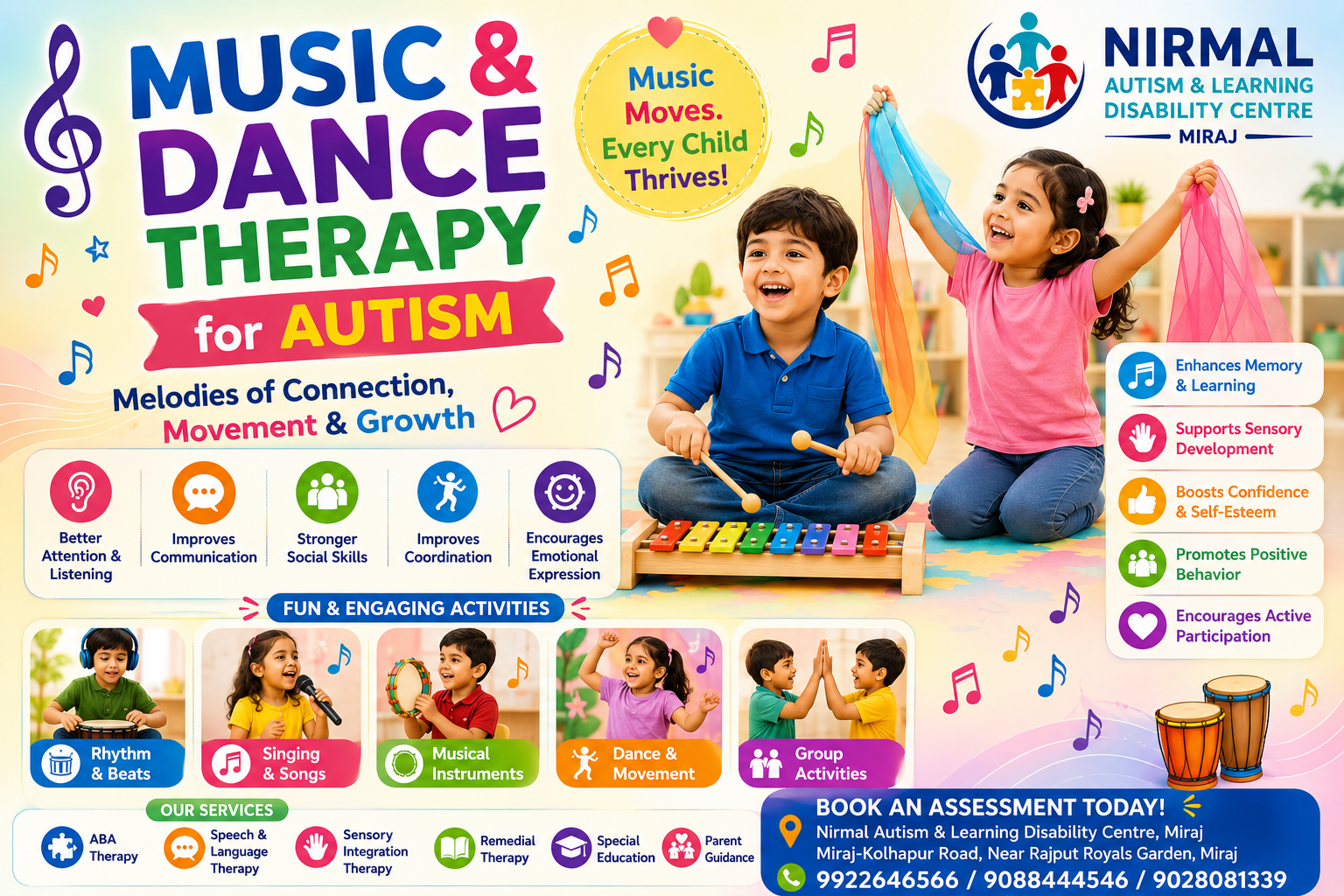
Music & Dance Therapy for autism uses structured music, rhythm and movement activities to support communication, social interaction, attention and emotional expression.
Music & Dance Therapy for Autism uses age-appropriate music, rhythm, movement and dance activities to encourage communication, social interaction, attention, coordination and positive participation in children.
Music & Dance Therapy for Autism
Music & Dance Therapy is a child-friendly approach that uses music, rhythm, movement and structured dance activities to encourage participation and support developmental goals.
For children with Autism Spectrum Disorder (ASD), music and movement activities can provide enjoyable opportunities to practice communication, social interaction, attention, imitation, coordination and emotional expression.
At Nirmal Autism & Learning Disability Centre, Miraj, music and movement activities can be incorporated into an individualized therapy program according to each child’s developmental level, abilities and goals.
Research on music-based interventions in autism has reported potential benefits in areas such as social responsiveness and behavior, although outcomes vary between studies and children.
What Is Music & Dance Therapy for Autism?
Music & Dance Therapy involves structured activities using:
- Music
- Rhythm
- Singing
- Clapping
- Musical instruments
- Movement
- Dance
- Action songs
- Imitation
- Group activities
- Interactive games
These activities can make therapy more engaging while providing opportunities to practice specific developmental and functional skills.
The activities should be selected according to the child’s needs rather than assuming that music or dance will produce the same benefits for every child.
How Can Music & Dance Activities Support Children with Autism?
Music and movement can create structured opportunities for children to listen, respond, imitate, move and interact with others.
1. Attention and Listening
Rhythm and musical activities can encourage children to listen carefully, wait for cues and respond to changes in sound.
Activities may include:
- Stop-and-go music games
- Rhythm imitation
- Listening games
- Musical cues
- Action songs
2. Communication Skills
Music can provide opportunities for children to practice sounds, words, gestures and other forms of communication.
Activities may include:
- Singing familiar songs
- Repeating words
- Action songs
- Requesting preferred songs
- Turn-taking activities
3. Social Interaction
Interactive music and dance activities can encourage children to participate with therapists, parents and peers.
Children may practice:
- Turn-taking
- Sharing
- Imitation
- Joint participation
- Following group instructions
- Social responses
A systematic review of creative movement therapies found promising evidence for improvements in social communication following music-based interventions, while evidence for dance-based approaches was more limited.
4. Body Awareness and Movement
Dance and movement activities can encourage children to become more aware of their bodies and how they move through space.
Activities may include:
- Jumping
- Clapping
- Stretching
- Walking to rhythm
- Copying movements
- Following movement sequences
5. Coordination
Music-based movement activities can combine rhythm with body movements to encourage coordination.
Examples include:
- Clapping to a beat
- Moving hands and feet together
- Following simple dance patterns
- Marching to music
- Copying therapist movements
6. Emotional Expression
Music and movement can provide children with opportunities to express emotions in a structured and enjoyable environment.
Activities can include songs and movements representing:
- Happy
- Sad
- Excited
- Calm
- Angry
- Relaxed
7. Positive Participation
Enjoyable activities may encourage children to participate actively in therapy and group learning.
Music Therapy for Children with Autism
Music therapy uses musical experiences and structured therapeutic activities to address individualized goals.
Music may include:
- Singing
- Instrument playing
- Rhythm exercises
- Musical games
- Improvisation
- Movement with music
- Song-based communication
A systematic review and meta-analysis of eight randomized controlled trials involving 608 children found that music therapy was associated with a significant improvement in social reactions, although it did not show significant improvements across every measured autism outcome.
A newer 2025 meta-analysis of 13 randomized trials involving 1,160 children also reported improvement in behavioral symptom measures following music therapy, while emphasizing the need to interpret findings in the context of the available evidence.
Dance Therapy and Movement Activities for Autism
Dance and movement activities can combine physical movement, rhythm, imitation and social participation.
Children may be encouraged to:
- Copy movements
- Follow rhythms
- Move to music
- Perform simple sequences
- Participate in group dances
- Practice turn-taking
- Follow instructions
Research suggests that dance interventions may support social interaction and some autism-related outcomes, but studies differ in their methods, duration and quality.
Therefore, dance should be viewed as a supportive activity within an individualized program, rather than a cure for autism.
Music & Dance Therapy Activities
Therapy sessions can include a variety of engaging activities.
1. Singing Activities
Children participate in familiar songs and may be encouraged to imitate sounds, words or actions.
2. Action Songs
Songs involving gestures and body movements can encourage imitation and following instructions.
3. Rhythm and Clapping
Children copy simple rhythms using hands, drums or other child-friendly instruments.
4. Musical Instrument Activities
Age-appropriate instruments such as drums, shakers, bells and tambourines can be used during structured activities.
5. Stop-and-Go Games
Children move when the music plays and stop when the music stops.
This can provide opportunities to practice listening, attention and response to cues.
6. Movement Imitation
The therapist demonstrates a movement and encourages the child to copy it.
7. Dance Sequences
Simple movement sequences can encourage memory, coordination and following instructions.
8. Group Music Activities
Small-group activities can provide opportunities to practice participation, turn-taking and social interaction.
Benefits of Music & Dance Activities for Children
When appropriately selected and linked to individual goals, music and movement activities may support:
- Attention and listening
- Communication
- Social interaction
- Imitation
- Turn-taking
- Body awareness
- Movement coordination
- Emotional expression
- Participation
- Following instructions
- Rhythm awareness
- Group engagement
- Confidence during activities
Research on dance activities in children and adolescents with autism has reported positive effects on social skills and communication, although substantial variation between studies means results should be interpreted cautiously.
Music & Dance Therapy for Sensory Development
Some children with autism may have differences in the way they respond to sensory information.
Music and movement activities can provide structured sensory experiences involving:
- Auditory input
- Visual input
- Movement
- Body awareness
- Rhythm
- Balance
- Coordination
Activities should be adapted to the child’s sensory preferences and tolerance.
For example, children who are sensitive to loud sounds may need quieter music, gradual exposure and appropriate breaks.
Music & Dance Therapy for Social Skills
Social interaction can be practiced through enjoyable, predictable activities.
1. Turn-Taking
The child waits while another person plays an instrument or performs a movement.
2. Imitation
The child copies a therapist’s or peer’s action.
3. Joint Participation
Children participate in the same song or movement activity with others.
4. Following Group Instructions
Children practice responding to simple instructions such as:
- Stand
- Sit
- Clap
- Jump
- Turn
- Stop
- Go
5. Peer Interaction
Age-appropriate group activities can provide opportunities for children to interact with peers.
Music & Dance Therapy for Attention and Concentration
Music can provide predictable patterns, repetition and cues that may help structure an activity.
Activities can include:
- Listening for specific sounds
- Waiting for musical cues
- Copying rhythms
- Following movement sequences
- Stop-and-go games
- Remembering song actions
The therapist can gradually increase the complexity of activities according to the child’s ability.
Music & Dance Therapy for Memory and Learning
Songs and repeated movement patterns can create opportunities to practice remembering:
- Words
- Actions
- Rhythms
- Sequences
- Instructions
- Movement patterns
For example, a child may learn a three-step movement routine and gradually progress to longer sequences.
However, improvements should be evaluated according to the child’s individual goals rather than assuming that music automatically improves memory.
Music & Dance Therapy and Behavior
Music and movement activities can be incorporated into a broader behavioral and developmental program.
Structured activities may encourage:
- Waiting
- Following instructions
- Transitioning between activities
- Appropriate participation
- Turn-taking
- Positive engagement
Music therapy research has reported potential improvements in behavioral measures in children with autism, but it should not be presented as a standalone treatment for all behavioral difficulties.
Assessment Before Music & Dance Therapy
An individualized assessment helps determine how music and movement activities can best be incorporated into a child’s program.
1. Developmental Assessment
The child’s developmental strengths and areas requiring support may be considered.
2. Communication Assessment
Communication abilities and preferred communication methods can be reviewed.
3. Sensory Profile
The child’s responses to sound, movement, touch and other sensory experiences may be considered.
4. Motor Skills
Balance, coordination, body awareness and movement abilities can be considered.
5. Social Skills
The therapist may observe:
- Eye gaze
- Imitation
- Turn-taking
- Joint participation
- Social response
6. Individual Therapy Goals
Activities should be connected to specific, meaningful goals for the child.
What Happens During a Music & Dance Therapy Session?
A session can be structured around the child’s individual needs.
A typical session may include:
- Warm-up activity
- Greeting song
- Listening activity
- Rhythm or instrument activity
- Action song
- Movement imitation
- Dance or movement sequence
- Turn-taking activity
- Cool-down activity
- Positive reinforcement and transition
The exact structure can vary according to the child’s age, developmental level and therapy goals.
Parent Involvement in Music & Dance Activities
Parents can continue appropriate music and movement activities at home.
1. Sing Familiar Songs
Use songs that the child enjoys and already recognizes.
2. Use Simple Action Songs
Encourage actions such as clapping, waving, jumping and marching.
3. Create Turn-Taking Games
Take turns playing a drum, shaker or other safe instrument.
4. Follow the Child’s Interests
Use preferred songs and activities to encourage participation.
5. Keep Activities Short and Enjoyable
Avoid forcing participation and provide breaks when the child becomes overwhelmed.
Parents should follow individualized recommendations from the child’s therapist.
Music & Dance Therapy at Nirmal Autism & Learning Disability Centre, Miraj
At Nirmal Autism & Learning Disability Centre, Miraj, music and movement activities can be incorporated into child-focused developmental and educational programs.
Our services include:
1. Music & Movement Activities
Structured music, rhythm and movement activities based on the child’s goals.
2. Sensory Integration Therapy
Sensory-motor activities based on individual assessment.
3. ABA Therapy
Individualized behavioral and developmental support where appropriate.
4. Remedial Therapy
Academic and learning support for children with learning difficulties.
5. Special Education
Individualized educational support according to the child’s learning profile.
6. Speech & Language Support
Communication-focused activities according to the child’s needs.
7. Parent Guidance
Support and guidance for parents to encourage development at home.
Is Music & Dance Therapy a Cure for Autism?
No.
Music & Dance Therapy is not a cure for Autism Spectrum Disorder.
It can be used as a supportive approach to address specific goals such as participation, communication, social interaction, movement, attention and emotional expression.
Autistic children have different strengths and support needs, so therapy should be individualized and integrated with other appropriate developmental, educational and therapeutic services.
Frequently Asked Questions About Music & Dance Therapy for Autism
1. What is Music & Dance Therapy for Autism?
Music & Dance Therapy uses structured music, rhythm, movement and dance activities to support individualized developmental, communication, social and functional goals.
2. Can music therapy help children with autism?
Research suggests that music therapy may support certain areas, particularly social responsiveness and some behavioral outcomes, although benefits vary and music therapy does not improve every autism-related outcome.
3. Can dance help children with autism?
Some research suggests that dance activities may support social interaction and communication. However, evidence is still developing and results vary across studies.
4. What activities are used in Music & Dance Therapy?
Activities may include singing, rhythm games, musical instruments, action songs, movement imitation, dance sequences, stop-and-go games and group activities.
5. Can Music & Dance Therapy improve communication?
Music-based activities can provide opportunities for children to practice communication, imitation and social responses. It should be considered part of a broader individualized communication program when appropriate.
6. Can Music & Dance Therapy improve social skills?
Music and dance activities can create structured opportunities for turn-taking, imitation, joint participation and peer interaction.
7. Is Music & Dance Therapy suitable for every autistic child?
Not necessarily. Activities should be selected according to the child’s developmental level, sensory preferences, communication abilities and individual goals.
8. Can parents do music activities at home?
Yes. Simple songs, action games, rhythm activities and turn-taking games can be incorporated into daily routines when appropriate.
9. How long does Music & Dance Therapy take?
There is no fixed duration. Frequency and duration depend on the child’s goals, response to activities and overall therapy plan.
When Should Parents Seek Professional Support?
Parents may consider a developmental assessment if their child experiences persistent difficulties with:
- Communication
- Social interaction
- Attention
- Imitation
- Following instructions
- Movement coordination
- Body awareness
- Emotional expression
- Group participation
- Sensory responses
A professional assessment can help identify appropriate developmental and therapeutic goals.
Support Your Child Through Music, Movement & Learning
If you want to Book an Assessment click here
Music and movement can make developmental activities engaging, interactive and enjoyable.
If your child needs support with communication, social interaction, attention, coordination or participation, an individualized assessment can help determine appropriate therapy goals.
At Nirmal Autism & Learning Disability Centre, Miraj, child-focused programs are planned according to individual developmental and learning needs.