Brain Gym Exercises for Autism | Nirmal Autism Centre Miraj
Brain Gym exercises for autism use structured movement activities to encourage attention, coordination, participation and learning-related skills as part of an individualized therapy program.
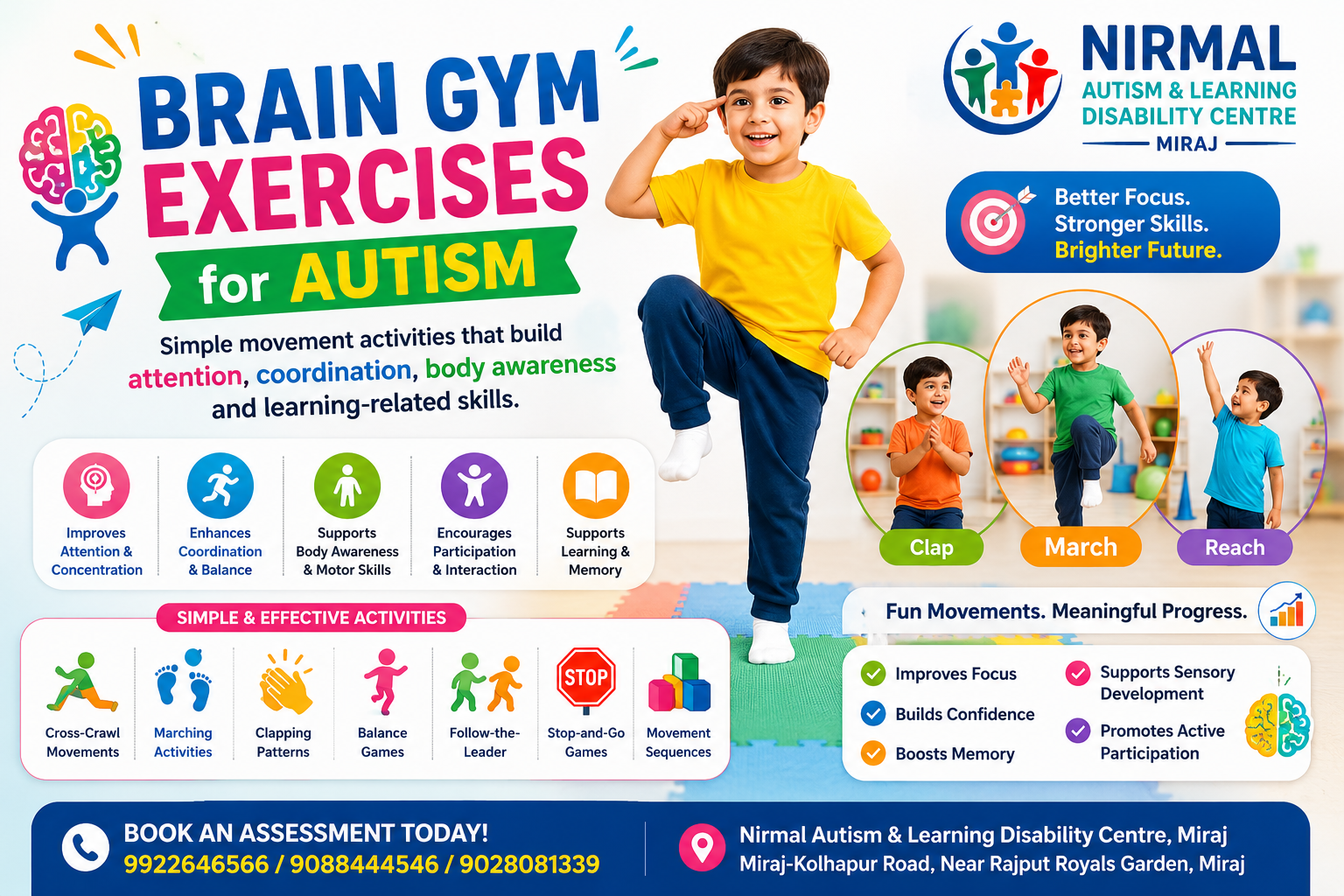
Brain Gym Exercises for Autism use simple, structured movement and coordination activities to encourage attention, body awareness, participation and learning-related skills in children.
Brain Gym Exercises for Autism
Brain Gym Exercises are structured movement activities that can be incorporated into a child’s developmental or educational program to encourage attention, coordination, body awareness, movement and active participation.
For children with Autism Spectrum Disorder (ASD), movement-based activities can provide enjoyable opportunities to practice following instructions, imitation, coordination, balance and engagement.
At Nirmal Autism & Learning Disability Centre, Miraj, movement activities are selected according to the child’s developmental level, abilities, sensory preferences and individual goals.
Brain Gym should be considered a complementary activity rather than a cure or standalone treatment for autism. Research specifically examining Brain Gym in autistic children remains limited and mixed.
What Are Brain Gym Exercises?
Brain Gym is a group of structured movement activities associated with educational kinesiology. Activities may involve simple body movements, stretching, coordination and cross-body movements.
In a child-focused setting, movement activities can be used to create opportunities for:
- Attention
- Listening
- Following instructions
- Imitation
- Balance
- Coordination
- Body awareness
- Motor planning
- Participation
- Movement control
The activities should be selected according to the child’s individual needs and should not replace evidence-based educational, behavioral, speech-language or occupational interventions.
Brain Gym Exercises and Autism
Children with autism have different developmental strengths and support needs.
Some children may experience challenges with:
- Attention
- Sitting and participating in activities
- Following instructions
- Motor coordination
- Balance
- Body awareness
- Imitation
- Motor planning
- Transitioning between activities
- Group participation
Movement-based activities may provide structured opportunities to practice some of these skills.
However, Brain Gym should not be presented as a treatment for the core characteristics of autism. A 2025 review found mixed findings and limited-quality evidence regarding Brain Gym for behavioral difficulties in children with ASD.
How Can Movement Activities Support Children?
When appropriately selected and linked to meaningful goals, movement activities can encourage children to actively participate in therapy and learning.
1. Attention and Concentration
Short movement activities can be used before or between learning tasks to encourage active participation and readiness.
Examples include:
- Follow-the-movement games
- Stop-and-go activities
- Rhythm movements
- Simple stretching
- Action sequences
2. Body Awareness
Movement activities can help children practice awareness of body position and movement.
Activities may include:
- Touching body parts
- Reaching
- Stretching
- Balancing
- Moving around obstacles
3. Motor Coordination
Activities can involve coordinated movements of the arms, legs and body.
Examples include:
- Clapping
- Marching
- Throwing and catching
- Cross-body movements
- Simple movement patterns
4. Balance
Age-appropriate balance activities can encourage controlled movement and body stability.
Examples include:
- Walking along a line
- Standing on one foot with support
- Stepping over obstacles
- Balance games
5. Following Instructions
Movement games can encourage children to listen and respond to simple instructions.
For example:
“Clap – Stop – Jump – Sit.”
The complexity can gradually increase according to the child’s abilities.
6. Imitation
The therapist demonstrates a movement and encourages the child to copy it.
Imitation activities can include:
- Clapping
- Waving
- Tapping
- Jumping
- Reaching
- Marching
7. Participation
Fun and predictable movement activities can encourage children to participate actively in therapy and group activities.
Brain Gym Activities for Children with Autism
Brain Gym-style movement activities can be adapted to the child’s age and developmental level.
1. Cross-Crawl Movements
The child performs alternating movements involving the opposite hand and leg.
Activities should be adapted for the child’s motor abilities and performed safely.
2. Marching Activities
Children can march in place or move around a designated area while following simple instructions.
3. Clapping Patterns
The therapist demonstrates a simple rhythm and the child attempts to copy it.
Example:
Clap – Clap – Pause – Clap
4. Touch and Reach Activities
Children reach toward objects or touch specified body parts.
5. Balance Games
Simple balance activities can be incorporated into play.
6. Follow-the-Leader
The therapist or parent performs a movement and the child imitates it.
7. Stop-and-Go Games
Children move when instructed to “Go” and stop when they hear “Stop.”
8. Movement Sequences
Children can practice short sequences such as:
Clap → Jump → Turn → Sit
The sequence can gradually become more complex.
Brain Gym Exercises for Attention and Concentration
Attention can be practiced through short, structured movement games.
Activities may include:
- Listening for a cue
- Responding to “stop” and “go”
- Copying movement patterns
- Following two-step instructions
- Rhythm imitation
- Movement sequencing
- Visual-motor games
The goal is to connect movement activities with a specific functional goal, rather than assuming that Brain Gym automatically improves concentration.
Evidence supporting broad Brain Gym claims about learning and cognitive improvement has historically been limited.
Brain Gym Exercises for Memory and Learning
Movement sequences can provide opportunities to practice remembering actions and instructions.
1. Remember the Movement
The therapist demonstrates two movements and asks the child to repeat them.
Example:
Clap → Jump
The sequence can gradually increase:
Clap → Jump → Turn
2. Remember the Rhythm
Children copy a short rhythm using clapping or simple instruments.
3. Movement and Picture Matching
Children perform a movement associated with a picture or symbol.
4. Action Songs
Songs combined with repeated movements can make learning more engaging.
Brain Gym for Motor Coordination
Movement coordination is an important part of many everyday activities.
Structured activities can encourage:
- Hand-eye coordination
- Bilateral coordination
- Balance
- Reaching
- Throwing
- Catching
- Crossing the body’s midline
- Movement sequencing
These activities should be selected according to the child’s motor abilities and functional goals.
Brain Gym and Sensory-Motor Activities
Some children with autism have differences in sensory processing and responses to movement.
Movement activities may provide opportunities for sensory-motor experiences involving:
- Movement
- Balance
- Body awareness
- Proprioception
- Visual attention
- Motor planning
However, sensory-motor activities should be individualized.
Children who become overwhelmed by movement, noise or crowded environments may require modifications, slower progression or breaks.
Check out our Sensory Integration Games आणि Speech Therapy video click here
Brain Gym Activities for Social Skills
Movement games can also be used as opportunities for social participation.
1. Turn-Taking
The child waits while another person performs a movement.
2. Imitation
The child copies the therapist or another child.
3. Group Movement
Children participate in the same activity together.
4. Following Group Instructions
Children respond to simple instructions such as:
- Stand
- Sit
- Clap
- Jump
- Turn
- Stop
- Go
5. Partner Activities
Simple partner games can encourage shared participation and interaction.
Brain Gym Exercises for Behavior and Participation
Movement activities may be incorporated into a broader developmental or behavioral program to encourage structured participation.
Activities can provide opportunities to practice:
- Waiting
- Following instructions
- Transitioning
- Turn-taking
- Staying engaged
- Completing an activity
- Responding to cues
A 2024 randomized clinical trial involving 36 children with ASD reported improvements in measured behavioral problems after a 10-session Brain Gym intervention, but the broader evidence base remains small and mixed.
Therefore, Brain Gym should be used as a complementary activity, with progress evaluated through meaningful individual goals.
Benefits of Structured Movement Activities
When appropriately planned, movement activities may help provide opportunities to practice:
- Attention
- Listening
- Body awareness
- Balance
- Coordination
- Motor planning
- Imitation
- Following instructions
- Memory of movement sequences
- Turn-taking
- Group participation
- Active engagement
Important: These should be treated as potential areas of support, not guaranteed outcomes.
What Happens During a Brain Gym Session?
A session can be adapted according to the child’s age, developmental level and goals.
A typical activity session may include:
- Greeting and preparation
- Simple warm-up
- Stretching or body movements
- Cross-body or coordination activity
- Balance activity
- Imitation game
- Movement sequence
- Attention or listening game
- Functional activity
- Cool-down and transition
The activities and duration can vary from child to child.
Assessment Before Brain Gym Exercises
An individualized assessment can help determine which movement activities are appropriate.
1. Developmental Assessment
The child’s developmental strengths and areas requiring support are considered.
2. Motor Skills Assessment
Relevant areas may include:
- Balance
- Coordination
- Gross motor skills
- Bilateral coordination
- Motor planning
3. Attention and Participation
The therapist may observe how the child responds to instructions, activities and environmental distractions.
4. Sensory Considerations
The child’s response to movement, sound, touch and other sensory experiences can be considered.
5. Functional Goals
Movement activities should be connected to meaningful goals such as participation in play, school or everyday activities.
Parent Involvement in Movement Activities
Parents can support appropriate movement activities at home when recommended by the child’s therapist.
1. Simple Movement Games
Use easy activities such as:
- Clapping
- Marching
- Jumping
- Reaching
- Stretching
2. Follow-the-Leader
Take turns leading simple movements.
3. Stop-and-Go
Use simple instructions such as “Go” and “Stop.”
4. Movement Songs
Combine songs with simple actions.
5. Keep Activities Short
Short, enjoyable activities may be easier for children who have limited attention or become tired quickly.
Parents should follow individualized recommendations from their child’s therapist.
Brain Gym Exercises at Nirmal Autism & Learning Disability Centre, Miraj
At Nirmal Autism & Learning Disability Centre, Miraj, movement-based activities can be incorporated into individualized developmental and educational programs.
Our services include:
1. Brain Gym & Movement Activities
Structured movement and coordination activities based on the child’s individual goals.
2. Sensory Integration Therapy
Sensory-motor activities based on individual assessment.
3. ABA Therapy
Individualized behavioral and developmental support where appropriate.
4. Remedial Therapy
Learning and academic support for children with developmental or learning difficulties.
5. Special Education
Individualized educational support according to the child’s learning profile.
6. Speech & Language Support
Communication-focused intervention according to the child’s needs.
7. Parent Guidance
Practical guidance for parents to support development at home.
Is Brain Gym a Treatment or Cure for Autism?
No.
Brain Gym exercises are not a cure for Autism Spectrum Disorder.
They should not replace established interventions such as appropriate speech-language therapy, occupational therapy, behavioral/developmental interventions, special education or other clinically indicated services.
The current research on Brain Gym specifically for autism is limited. A 2025 review found mixed findings, with some studies reporting improvements and others finding no significant effects, while also identifying methodological limitations.
The most appropriate approach is to use movement activities when they are safe, enjoyable and connected to meaningful goals for the individual child.
Brain Gym vs. Exercise and Motor Activities
Brain Gym is often discussed separately from general physical exercise and motor activities.
1. Brain Gym
Typically refers to a specific set of structured movements associated with the Brain Gym program.
2. General Exercise
Includes activities such as:
- Walking
- Running
- Swimming
- Cycling
- Sports
- Playground activities
3. Motor Activities
Focus on specific movement skills such as:
- Balance
- Coordination
- Fine motor skills
- Gross motor skills
- Motor planning
These approaches should not automatically be considered interchangeable.
For children with autism, physical activity can also provide opportunities for participation, fitness and social engagement. However, the specific benefits depend on the activity and individual child.
If you want to know about our ADHD Service click here
Frequently Asked Questions About Brain Gym for Autism
1. What are Brain Gym Exercises for Autism?
Brain Gym Exercises are structured movement activities that may be incorporated into a child’s developmental program to encourage movement, coordination, attention and participation.
2. Can Brain Gym cure autism?
No. Brain Gym does not cure autism and should not be presented as a cure or replacement for established autism interventions.
3. Can Brain Gym improve concentration?
Some studies have reported improvements in attention or concentration, but evidence for broad Brain Gym claims remains limited and inconsistent.
4. Can Brain Gym help children with autism?
A small number of studies have examined Brain Gym in children with ASD, with mixed findings. More high-quality research is needed before strong conclusions can be made.
5. What Brain Gym activities can children do?
Depending on the child’s abilities, activities may include cross-body movements, marching, clapping, balance games, imitation, stretching and movement sequences.
6. Is Brain Gym suitable for every autistic child?
No. Activities should be selected according to the child’s developmental, motor, sensory and functional needs.
7. Can parents do Brain Gym activities at home?
Parents can practice simple, safe movement activities when recommended by their child’s therapist. Professional guidance is especially useful when a child has significant motor, sensory or developmental difficulties.
8. How long should Brain Gym activities be performed?
There is no universal duration. Activity length should depend on the child’s age, tolerance, goals and response.
9. Can Brain Gym replace occupational therapy?
No. Brain Gym should not be considered a replacement for occupational therapy or other clinically indicated interventions.
When Should Parents Seek Professional Support?
Parents may consider a developmental assessment when a child has persistent difficulties with:
- Attention
- Following instructions
- Balance
- Coordination
- Motor planning
- Body awareness
- Imitation
- Participation
- Social interaction
- Learning-related activities
- Sensory responses
A professional assessment can help identify the child’s strengths and determine appropriate developmental goals.
Support Your Child Through Movement & Learning
Every child has a unique developmental profile.
If your child experiences difficulties with attention, coordination, movement, participation or learning-related activities, an individualized assessment can help identify appropriate support.
At Nirmal Autism & Learning Disability Centre, Miraj, child-focused programs are planned around individual developmental and functional needs.