Midline Crossing Activities for Autism
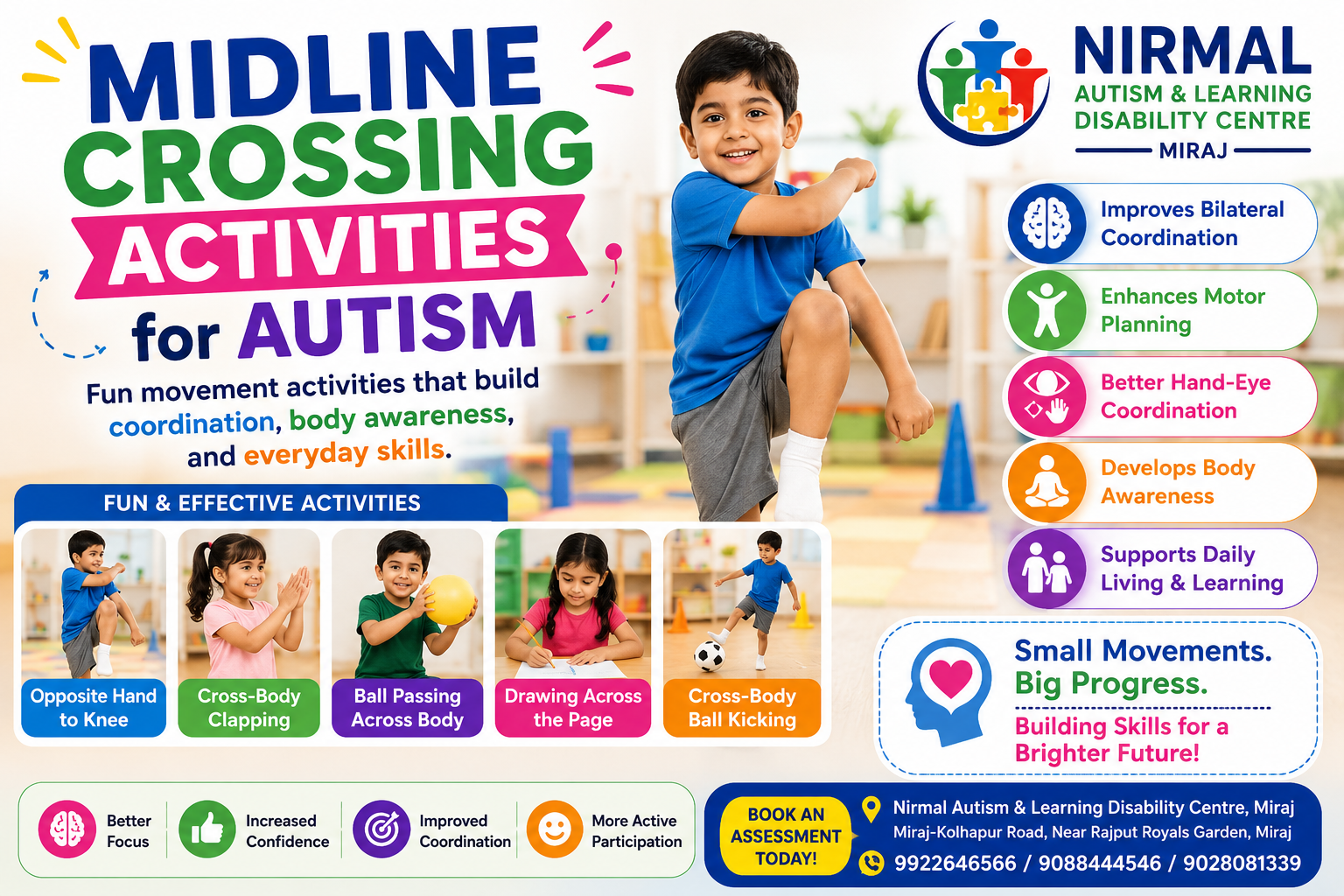
Midline Crossing Activities for autism support bilateral coordination, motor planning, body awareness, hand-eye coordination and functional participation through structured movement activities.
Midline Crossing Activities help children practice using both sides of the body together through fun, structured movements that support coordination, motor planning, body awareness and everyday skills.
Midline Crossing Activities for Autism
Midline Crossing Activities are movement-based activities that encourage children to move one hand, arm, leg or eye across the imaginary line dividing the left and right sides of the body.
For children with autism, these activities can provide opportunities to practice bilateral coordination, motor planning, body awareness, hand-eye coordination and movement control.
At Nirmal Autism & Learning Disability Centre, Miraj, midline-crossing activities can be incorporated into an individualized therapy program according to the child’s developmental level, motor abilities and functional goals.
Crossing the body’s midline is recognized within occupational therapy as one aspect of movement-related function, alongside bilateral integration, fine and gross motor control and eye-hand coordination.
What Is Midline Crossing?
The body midline is an imaginary vertical line that divides the body into a left and right side.
Crossing the midline means moving a body part from one side of the body to the other.
Simple Example
If a child uses the right hand to reach for a toy placed on the left side, the right hand crosses the body’s midline.
Similarly, activities such as:
- Touching the left knee with the right hand
- Reaching across the body
- Drawing across a page
- Passing an object from one side to another
- Kicking a ball toward the opposite side
can provide opportunities to practice midline crossing.
Why Is Midline Crossing Important for Children?
Midline crossing is connected with everyday movement and coordinated activities.
It can be practiced as part of activities involving:
- Bilateral coordination
- Hand-eye coordination
- Motor planning
- Body awareness
- Visual tracking
- Reaching
- Fine motor skills
- Gross motor skills
- Functional play
Occupational therapists assess movement skills in relation to meaningful activities and participation rather than focusing on an isolated movement skill alone.
Midline Crossing and Autism
Every autistic child has a unique developmental profile.
Some children may experience challenges related to:
- Bilateral coordination
- Motor planning
- Balance
- Body awareness
- Hand-eye coordination
- Following movement sequences
- Fine motor activities
- Gross motor activities
- Visual-motor skills
Midline-crossing activities can be incorporated into therapy when these skills are relevant to the child’s functional goals.
They should not be presented as a treatment or cure for autism. Instead, they can be one component of a broader, individualized developmental or occupational therapy program.
How Can Midline Crossing Activities Support Children?
1. Bilateral Coordination
Children can practice using both sides of their body together during movement and play.
Examples:
- Clapping
- Catching a ball
- Pulling objects
- Two-handed activities
- Cross-body movements
2. Motor Planning
Cross-body activities can give children opportunities to plan, organize and perform movement sequences.
3. Hand-Eye Coordination
Reaching across the body toward a target can combine visual attention with controlled hand movement.
4. Body Awareness
Movement activities can help children become more aware of where their hands, arms, legs and body are positioned.
5. Visual-Motor Skills
Activities involving reaching, drawing, catching and target games can combine visual information with movement.
6. Functional Participation
The ultimate goal should be connecting movement skills with meaningful activities such as play, dressing, schoolwork and self-care.
Midline Crossing Activities for Children with Autism
Fun and simple activities can be incorporated into therapy sessions.
1. Opposite Hand to Knee
Ask the child to touch the left knee with the right hand, then the right knee with the left hand.
Example:
Right hand → Left knee
Left hand → Right knee
This can be made into a simple rhythm game.
2. Cross-Body Clapping
Ask the child to touch or clap one hand toward the opposite side.
The therapist can demonstrate slowly and encourage imitation.
3. Reach for Toys Across the Body
Place toys on the opposite side and encourage the child to reach across the body to pick them up.
This can be incorporated into play rather than presented as repetitive exercise.
4. Ball Passing Across the Body
Place a ball slightly to one side and encourage the child to reach across the body to pick it up and move it to the opposite side.
5. Cross-Body Bean Bag Toss
Children can pick up a bean bag from one side and place or toss it toward a target on the opposite side.
6. Drawing Across the Page
Encourage children to draw simple lines, shapes or patterns across the page.
This can be incorporated into:
- Drawing
- Coloring
- Tracing
- Maze activities
- Pre-writing activities
7. Sticker Crossing Activity
Place stickers on both sides of a worksheet and encourage the child to reach across the body to place or collect them.
8. Cross-Body Ball Kicking
Place a ball toward one side and encourage the child to kick toward a target on the opposite side.
Activities should be adapted to the child’s balance and motor abilities.
9. Follow-the-Leader
The therapist demonstrates movements such as:
Right hand → Left shoulder → Left hand → Right shoulder
The child imitates the sequence.
10. Cross-Body Action Songs
Songs combined with movements can make midline-crossing activities more enjoyable.
For example:
Touch Left → Touch Right → Clap → Reach Across
Midline Crossing Activities for Fine Motor Skills
Midline crossing can also be incorporated into tabletop activities.
1. Drawing
Children can draw lines or shapes across the page.
2. Coloring
Encourage reaching toward different areas of the page.
3. Sticker Activities
Children can pick and place stickers across different areas of a worksheet.
4. Puzzle Activities
Pieces can be positioned on different sides of the workspace.
5. Object Sorting
Objects can be placed on one side and sorted into containers positioned on the opposite side.
These activities should always be connected to meaningful functional goals.
Midline Crossing Activities for Gross Motor Skills
Gross motor activities can provide larger movement opportunities.
1. Marching
Children can practice alternating arm and leg movements.
2. Crawling
Crawling games can involve alternating movements of the hands and knees.
3. Ball Games
Throwing, catching, rolling and kicking can incorporate movement across the body.
4. Obstacle Activities
Children can reach, step, walk and move around objects positioned on different sides.
5. Dance and Movement
Simple dance patterns can include movements across both sides of the body.
Midline Crossing and Hand-Eye Coordination
Many everyday activities require children to coordinate what they see with how they move their hands.
Midline-crossing activities can incorporate:
- Reaching for targets
- Catching
- Throwing
- Placing objects
- Drawing
- Puzzles
- Ball games
- Target activities
The activity should be adjusted according to the child’s visual, motor and developmental abilities.
Midline Crossing and School Skills
Midline crossing may be relevant to activities that require coordinated visual and motor performance.
Examples include:
- Drawing
- Coloring
- Cutting
- Writing
- Copying shapes
- Using worksheets
- Handling classroom materials
- Reaching for objects on a desk
However, difficulty with a particular school skill should be assessed individually rather than automatically attributed to midline crossing.
Midline Crossing and Daily Activities
Movement coordination is important in many everyday tasks.
Children may practice coordinated movements during:
- Dressing
- Buttoning
- Eating
- Playing
- Brushing teeth
- Using classroom materials
- Carrying objects
- Playing with toys
The focus should be on improving functional participation, not simply completing a particular exercise.
AOTA emphasizes linking pediatric occupational therapy interventions to meaningful activities and measurable functional goals.
Assessment Before Midline Crossing Activities
An individualized assessment can help determine which activities are appropriate.
1. Motor Skills Assessment
The therapist may consider:
- Gross motor skills
- Fine motor skills
- Balance
- Coordination
- Motor planning
2. Bilateral Coordination
The child’s ability to use both sides of the body together can be observed during age-appropriate activities.
3. Visual-Motor Skills
The therapist may observe how visual information is combined with hand movements.
4. Body Awareness
Body positioning and awareness during movement can be considered.
5. Functional Skills
The therapist may look at how movement difficulties affect:
- Play
- School activities
- Self-care
- Dressing
- Feeding
- Everyday participation
What Happens During a Midline Crossing Activity Session?
Activities can be structured around the child’s individual goals.
A session may include:
- Warm-up movement
- Body-awareness activity
- Cross-body movement
- Bilateral coordination activity
- Ball or target activity
- Fine motor activity
- Visual-motor activity
- Movement sequence
- Functional activity
- Cool-down
The exact activities and difficulty level can be modified according to the child’s response and progress.
Parent Involvement in Midline Crossing Activities
Parents can incorporate simple movement activities into play when recommended by the child’s therapist.
1. Try Simple Games
Use activities such as:
- Opposite hand-to-knee
- Ball passing
- Sticker reaching
- Clapping patterns
- Drawing
- Follow-the-leader
2. Make Activities Fun
Use the child’s favorite toys, songs and games to encourage participation.
3. Avoid Pressure
Allow breaks and stop an activity if the child becomes tired, distressed or uncomfortable.
4. Follow Professional Guidance
Parents should follow the individualized home program recommended by the child’s therapist.
Midline Crossing Activities at Nirmal Autism & Learning Disability Centre, Miraj
At Nirmal Autism & Learning Disability Centre, Miraj, movement and coordination activities can be incorporated into individualized developmental and educational programs.
Our services include:
1. Midline Crossing Activities
Structured activities targeting bilateral coordination, movement planning and functional participation.
2. Sensory Integration Therapy
Individualized sensory-motor activities based on assessment.
3. Occupational Therapy
Activities focused on functional motor, self-care, school and participation goals.
4. ABA Therapy
Individualized behavioral and developmental support where appropriate.
5. Remedial Therapy
Learning and academic support for children with developmental or learning difficulties.
6. Special Education
Individualized educational support based on the child’s learning profile.
7. Parent Guidance
Practical guidance to help parents support their child’s development at home.
Is Midline Crossing Therapy a Cure for Autism?
No.
Midline Crossing Activities are not a cure for Autism Spectrum Disorder.
They are movement-based activities that may be incorporated into an individualized therapy program when a child has relevant motor, coordination, visual-motor or functional difficulties.
The goal is to connect activities with meaningful outcomes such as play, school participation, self-care, coordination and everyday functioning.
Occupational therapy guidance emphasizes purposeful, occupation-based intervention and individualized functional goals.
If you want to know about autism takea look at our autism video Click here
Frequently Asked Questions About Midline Crossing Activities
1. What are Midline Crossing Activities?
Midline Crossing Activities involve movements where a hand, arm, leg or visual focus moves across the body’s imaginary center line.
2. Why is crossing the midline important?
Crossing the midline can be involved in activities requiring bilateral coordination, motor planning, visual-motor control and coordinated use of both sides of the body.
3. Can autistic children do midline-crossing activities?
Yes, when activities are appropriate for the child’s developmental and motor abilities. They should be individualized according to the child’s needs.
4. What are examples of midline-crossing exercises?
Examples include opposite hand-to-knee movements, reaching across the body, ball games, drawing across a page, sticker activities and cross-body movement games.
5. Can midline crossing improve handwriting?
Midline crossing may be one component of the motor and visual-motor skills involved in handwriting, but handwriting difficulties have many possible causes and should be individually assessed.
6. Can midline crossing improve coordination?
These activities provide opportunities to practice coordination and bilateral movement. Progress should be evaluated through functional activities rather than assuming that every child will experience the same benefit.
7. Can parents practice midline crossing at home?
Yes. Simple activities can be practiced through play when recommended by the child’s therapist.
8. Is midline crossing therapy suitable for every autistic child?
No. Activities should be selected according to the child’s developmental, motor, sensory and functional needs.
9. Can midline crossing activities replace occupational therapy?
No. They should not replace occupational therapy or other clinically indicated interventions.
When Should Parents Seek Professional Support?
Parents may consider a professional assessment if their child has persistent difficulties with:
- Bilateral coordination
- Balance
- Motor planning
- Hand-eye coordination
- Fine motor skills
- Gross motor skills
- Body awareness
- Drawing or writing
- Dressing
- Self-care
- Play activities
- School participation
A professional assessment can help identify the underlying skills affecting the child’s everyday participation.
Support Your Child’s Coordination & Development
Every child has a unique developmental profile.
If your child experiences difficulties with coordination, motor planning, body awareness, hand-eye coordination or functional activities, an individualized assessment can help identify appropriate support.
At Nirmal Autism & Learning Disability Centre, Miraj, therapy programs are planned around each child’s developmental and functional needs.