Learn about Oppositional Defiant Disorder (ODD) in children, including symptoms, DSM-5 criteria, severity, assessment, ADHD comorbidity and treatment approaches.
Oppositional Defiant Disorder (ODD) in Children
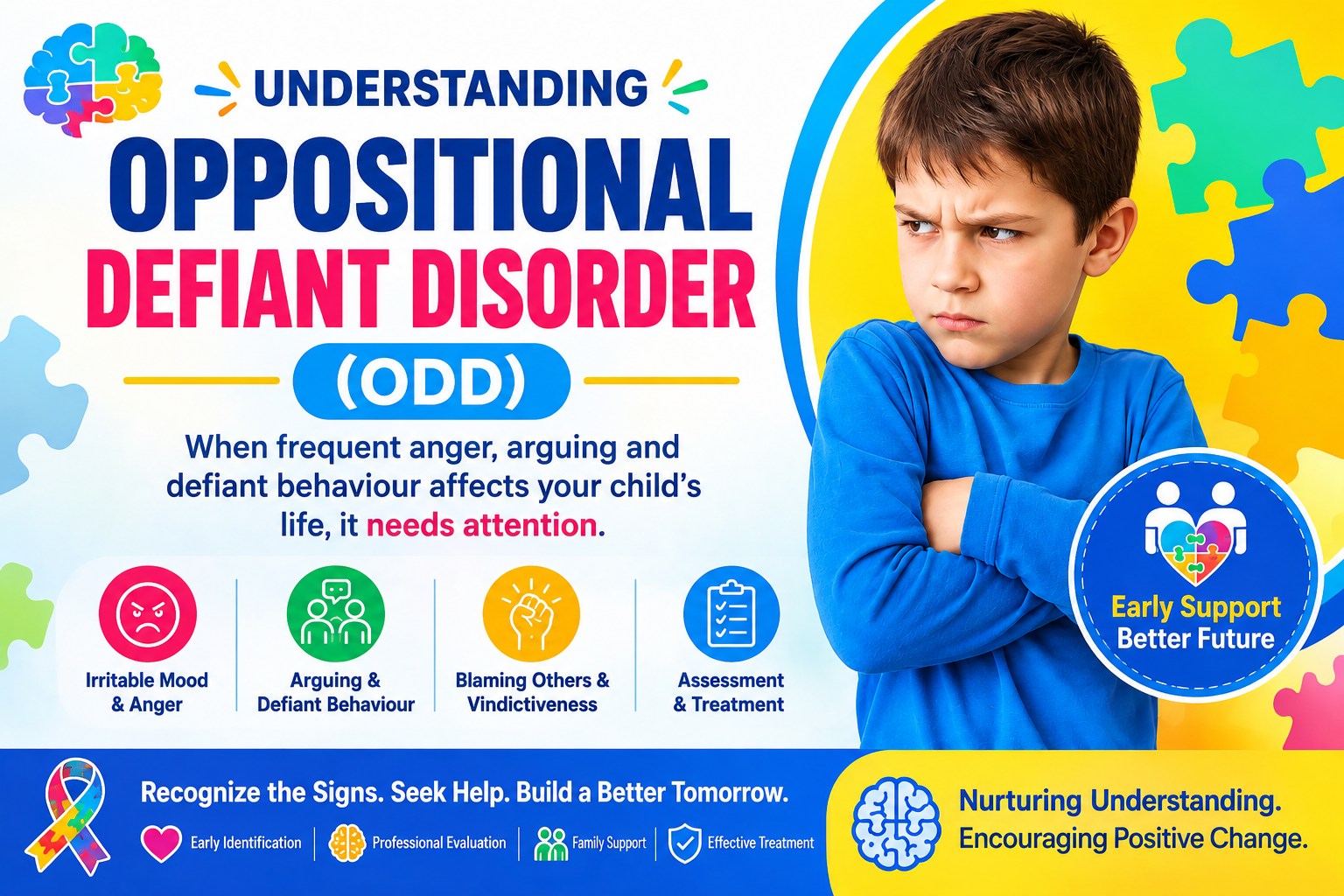
Oppositional Defiant Disorder (ODD) is a behavioural disorder characterized by a persistent pattern of angry or irritable mood, argumentative or defiant behaviour, and vindictiveness. Children with ODD may frequently argue with adults, refuse to follow rules, become easily annoyed, blame others for their mistakes, or deliberately annoy people.
The behaviour can affect relationships with parents, teachers and peers and may interfere with learning and social functioning. The presentation describes ODD as involving recurrent developmentally inappropriate, negativistic, defiant and disobedient behaviour toward authority figures.
What Is Oppositional Defiant Disorder?
Oppositional Defiant Disorder is more than occasional disobedience or childhood temper tantrums. Many children may argue, become angry or refuse instructions from time to time, particularly when they are tired, hungry or upset.
In Oppositional Defiant Disorder, these behaviours occur more frequently and repeatedly and can interfere with a child’s learning, relationships and everyday functioning. The presentation specifically highlights the difference between occasional behaviour and a persistent pattern of behaviour associated with ODD.
Watch this video to know more about ODD Click Here
ODD Behaviour in Children
Children with Oppositional Defiant Disorder may show difficulties when interacting with:
- Parents
- Teachers
- Other adults
- Siblings
- Peers
- Other authority figures
The symptoms may result in strained relationships with parents, teachers and peers.
Signs and Symptoms of Oppositional Defiant Disorder
The symptoms of Oppositional Defiant Disorder can generally be understood under three major groups:
1. Irritable or Angry Mood
A child may:
- Lose their temper easily
- Become easily annoyed
- Be touchy or sensitive
- Frequently become angry
- Show resentment
- Have frequent angry outbursts
These features are highlighted in the presentation under irritability and anger.
2. Argumentative and Defiant Behaviour
A child may:
- Frequently argue with adults
- Argue with authority figures
- Refuse to follow requests
- Refuse to comply with rules
- Deliberately annoy others
- Blame others for their own mistakes or misbehaviour
These behaviours are described in the Oppositional Defiant Disorder symptom sections of the presentation.
3. Vindictiveness
Vindictive behaviour may include:
- Being spiteful
- Seeking revenge
- Saying hurtful or hateful things when angry
- Holding resentment toward others
The presentation identifies vindictiveness as one of the three major symptom groups.
DSM-5 Criteria for Oppositional Defiant Disorder
According to the presentation’s DSM-5 section, ODD involves at least four symptoms out of eight, occurring on most days for at least six months. The symptoms fall within the domains of irritable mood, vindictiveness, and argumentative/defiant behaviour.
1. Irritable Mood Symptoms
- Often loses temper
- Often touchy or easily annoyed
- Often angry and resentful
- Vindictiveness
- Often vindictive
2. Argumentative / Defiant Symptoms
- Often argues with authority figures or adults
- Often actively refuses or defies requests or rules
- Often deliberately annoys others
- Often blames others for their mistakes or misbehaviour
These eight symptoms are presented in the uploaded material’s DSM-5 section.
Important: Having one or two of these behaviours occasionally does not automatically mean that a child has ODD. Diagnosis requires a proper clinical assessment.
How Is ODD Different From Normal Childhood Behaviour?
It is normal for children to sometimes:
- Argue with parents
- Refuse instructions
- Become angry
- Question rules
- Have temper tantrums
However, Oppositional Defiant Disorder is different because these behaviours are frequent, repetitive and disruptive.
According to the presentation, Oppositional Defiant Disorder symptoms occur more frequently and repeatedly and can interfere with learning and social relationships. The behaviour is not simply limited to a few isolated “bad” days.
When Should Parents Seek Professional Help?
Parents should consider a professional evaluation when a child’s oppositional behaviour:
- Happens repeatedly
- Is difficult to manage
- Occurs across everyday situations
- Affects school performance
- Causes problems with peers
- Creates significant family conflict
- Continues over an extended period
Severity of Oppositional Defiant Disorder
The presentation describes Oppositional Defiant Disorder severity according to the number of settings in which symptoms occur.
1. Mild ODD
Symptoms are confined to one setting.
2. Moderate ODD
Symptoms occur in at least two settings.
3. Severe ODD
Symptoms occur in three or more settings.
Possible settings include:
- Home
- School
- With peers
- Other social environments
Types or Symptom Patterns of ODD
The presentation describes three phenomenological features or symptom patterns:
1. Affective Symptoms
This pattern includes:
- Irritability
- Temper tantrums
- Resentful attitude
2. Defiance Symptoms
This pattern includes:
- Arguing
- Vindictiveness
- Defiant behaviour
3. Hurtful Symptoms
The presentation describes this pattern in terms of callousness and lack of regret.
Prevalence of Oppositional Defiant Disorder
The presentation reports that the estimated prevalence of Oppositional Defiant Disorder varies considerably, with a range of approximately 2% to 11%. It also notes that Oppositional Defiant Disorder is more common in preadolescent males than females.
The material further notes that symptoms may remain relatively stable between ages five and ten and may decline afterward.
Because prevalence estimates can vary according to diagnostic criteria, age group and population studied, professional assessment is important when significant behavioural concerns are present.
ODD and Other Mental Health Conditions
Oppositional Defiant Disorder can occur along with other mental health or developmental conditions.
The presentation reports comorbidity with:
- ADHD
- Affective disorders
- Specific learning disorder (SLD)
- Conduct Disorder (CD)
It specifically reports that 30–40% of children with ADHD may also have comorbid ODD, while the presentation also gives estimates for affective disorders and SLD.
ODD and ADHD
When ADHD and ODD occur together, children may experience difficulties with:
- Impulsivity
- Attention
- Emotional regulation
- Following instructions
- Behavioural control
The presentation emphasizes the importance of assessing for comorbid conditions.
ODD vs Conduct Disorder
Oppositional Defiant Disorder and Conduct Disorder (CD) are different conditions.
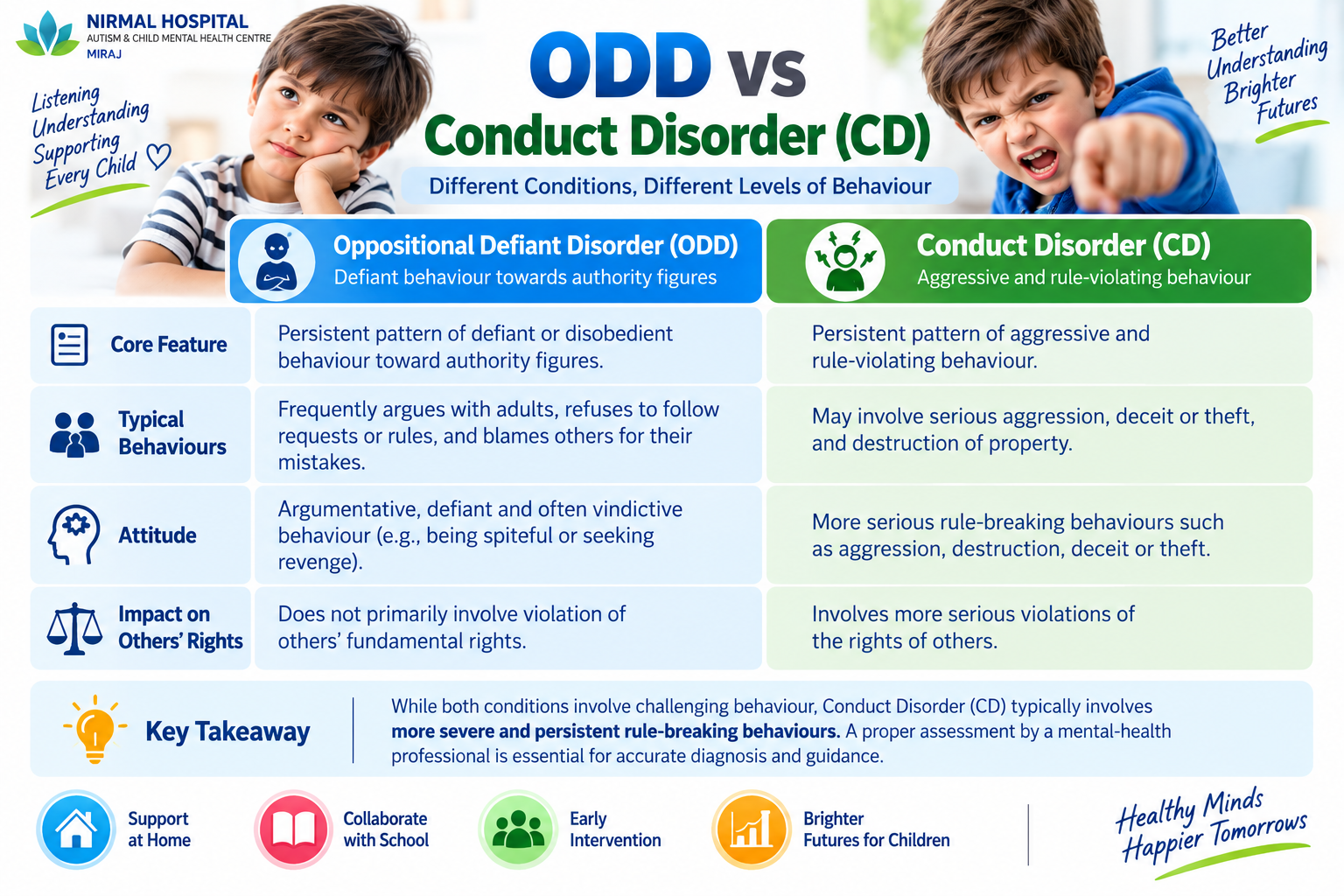
The presentation’s comparison highlights that CD involves more serious rule-breaking and behaviours such as aggression, destruction, deceit or theft.
How Is Oppositional Defiant Disorder Diagnosed?
Oppositional Defiant Disorder diagnosis requires a comprehensive clinical assessment rather than simply observing one difficult behaviour.
The presentation identifies several important components of assessment:
1. Clinical History
A detailed history helps understand:
- When the behaviour started
- How frequently it occurs
- Where it occurs
- Situations that trigger the behaviour
- How parents and others respond
- The impact on the child’s functioning
2. Behavioural Observation
Mental Status Examination and behavioural observation may form part of the assessment.
3. Information From Multiple Sources
The presentation recommends obtaining collateral information from relevant sources, including:
- Parents
- Teachers
- School reports
- Peers
- Relatives
- Siblings
- Counsellors
- Other relevant professionals
4. Family Assessment
Family assessment is also important, including assessment of parent-child interactions and family difficulties.
Screening for ODD
The presentation includes evidence-based screening questions covering behaviours such as:
- Vindictiveness or blaming others
- Being touchy or easily annoyed
- Losing temper
- Arguing with adults
- Defying adult requests
- Anger and resentment
- Deliberately annoying others
These questions can help identify children who may need further clinical assessment, but screening is not the same as diagnosis.
Assessment Tools for ODD
The presentation lists several structured or semi-structured assessment approaches, including:
- DISC-IV
- DICA
- K-SADS
- CAPA
- NICHQ Vanderbilt Assessment Scale
- SNAP-4th Edition
- Pediatric Symptom Checklist
A qualified mental-health professional determines which assessment approach is appropriate for an individual child.
Treatment for Oppositional Defiant Disorder
Treatment should be individualized according to the child’s age, behavioural symptoms, severity and coexisting conditions.
The presentation identifies psychosocial management as the mainstay of treatment.
1. Behavioural and Psychosocial Interventions
Treatment approaches described in the presentation include:
2. Parent Management Training (PMT)
Parent Management Training helps parents develop structured strategies for managing behaviour at home.
The presentation describes goals such as improving parent-child interaction, developing contingency-management skills and encouraging prosocial behaviour.
3. Parent-Child Interaction Therapy (PCIT)
PCIT is described as an evidence-based intervention for young children with behavioural problems.
It uses coaching to help parents improve their interactions with the child and manage challenging behaviour more effectively.
The presentation describes two phases of PCIT:
Phase 1: Building a warm parent-child relationship and learning behavioural principles.
Phase 2: Helping parents manage challenging behaviours while remaining calm, confident and consistent.
4. Cognitive Behavioural Therapy
Cognitive behavioural skill training may be particularly useful for adolescents.
The presentation describes goals including:
- Improving social problem-solving
- Anger management
- Reducing impulsivity
- Improving decision-making
- Developing problem-solving skills
5. Collaborative Problem Solving
Collaborative problem solving involves parents and children working together to address problems rather than relying only on parental demands or instructions.
The presentation emphasizes parental involvement and consistency.
6. Family Therapy
Family therapy may address:
- Communication
- Parenting style
- Reinforcement
- Parent-child relationships
The presentation also highlights family involvement as an important part of treatment.
To know about one of the Treatment named ABA Treatment click here
Role of Medication in ODD
The presentation states that the role of psychiatric medication in treating ODD directly is limited.
Medication may instead be considered for associated or coexisting conditions such as ADHD, mood disorders, anxiety or other clinical problems, according to the treating clinician’s assessment.
For this reason, medication should not be presented as the primary treatment for ODD itself.
Importance of Early Intervention
Early identification and intervention are important because persistent behavioural difficulties can affect:
- Family relationships
- School functioning
- Social relationships
- Emotional development
- Long-term behavioural outcomes
The presentation specifically emphasizes early intervention and education of children and parents/caregivers.
Course and Outcome of ODD
The presentation reports that follow-up studies found approximately 67% of treated children diagnosed with ODD were symptom-free after three years, while it also reports that approximately 30% may go on to develop Conduct Disorder. These figures should be understood in the context of the studies cited in the original presentation rather than as a prediction for an individual child.
The presentation also emphasizes that ODD is often under-recognized and may go undiagnosed or untreated.
When Should Parents Consult a Mental Health Professional?
Parents should consider seeking professional evaluation when a child consistently:
- Loses their temper
- Argues excessively with adults
- Refuses to follow rules
- Deliberately annoys others
- Blames others for mistakes
- Shows frequent resentment
- Seeks revenge
- Has repeated behavioural difficulties at home or school
A professional assessment can help determine whether the behaviour is part of ODD or another behavioural, developmental or mental-health condition.
Frequently Asked Questions About ODD
What is Oppositional Defiant Disorder?
Oppositional Defiant Disorder is a behavioural disorder involving a persistent pattern of irritable mood, argumentative or defiant behaviour and vindictiveness.
Is every stubborn or disobedient child diagnosed with ODD?
No. Occasional arguing, anger or refusal to follow instructions can occur during normal childhood development. ODD involves a persistent and clinically significant pattern of behaviour.
What are the main symptoms of ODD?
The main symptom groups are irritable/angry mood, argumentative or defiant behaviour, and vindictiveness.
Can ODD occur with ADHD?
Yes. The presentation reports that ODD commonly occurs with ADHD and provides an estimate of 30–40% comorbidity.
Is ODD the same as Conduct Disorder?
No. ODD primarily involves defiant, argumentative and vindictive behaviour, whereas Conduct Disorder involves more serious rule violations and behaviours that may violate the rights of others.
Can ODD be treated?
Yes. The presentation identifies psychosocial treatment as the mainstay and discusses parent management training, behavioural therapy, cognitive behavioural approaches, family therapy, collaborative problem solving and Parent-Child Interaction Therapy.
Does ODD require medication?
Medication has a limited direct role in ODD. Treatment may instead focus on psychosocial interventions and management of coexisting conditions when present.
Why Choose Professional Assessment for Child Behaviour Problems?
Persistent defiant or oppositional behaviour can sometimes be associated with other developmental, behavioural or emotional difficulties. A detailed assessment helps understand the child’s symptoms, family environment, school functioning and possible comorbid conditions.
At Nirmal Hospital, Miraj, parents can seek professional guidance when behavioural difficulties are persistent or interfering with the child’s daily life.