ABA Therapy for Autism in Miraj | Build Communication, Social & Daily Living Skills
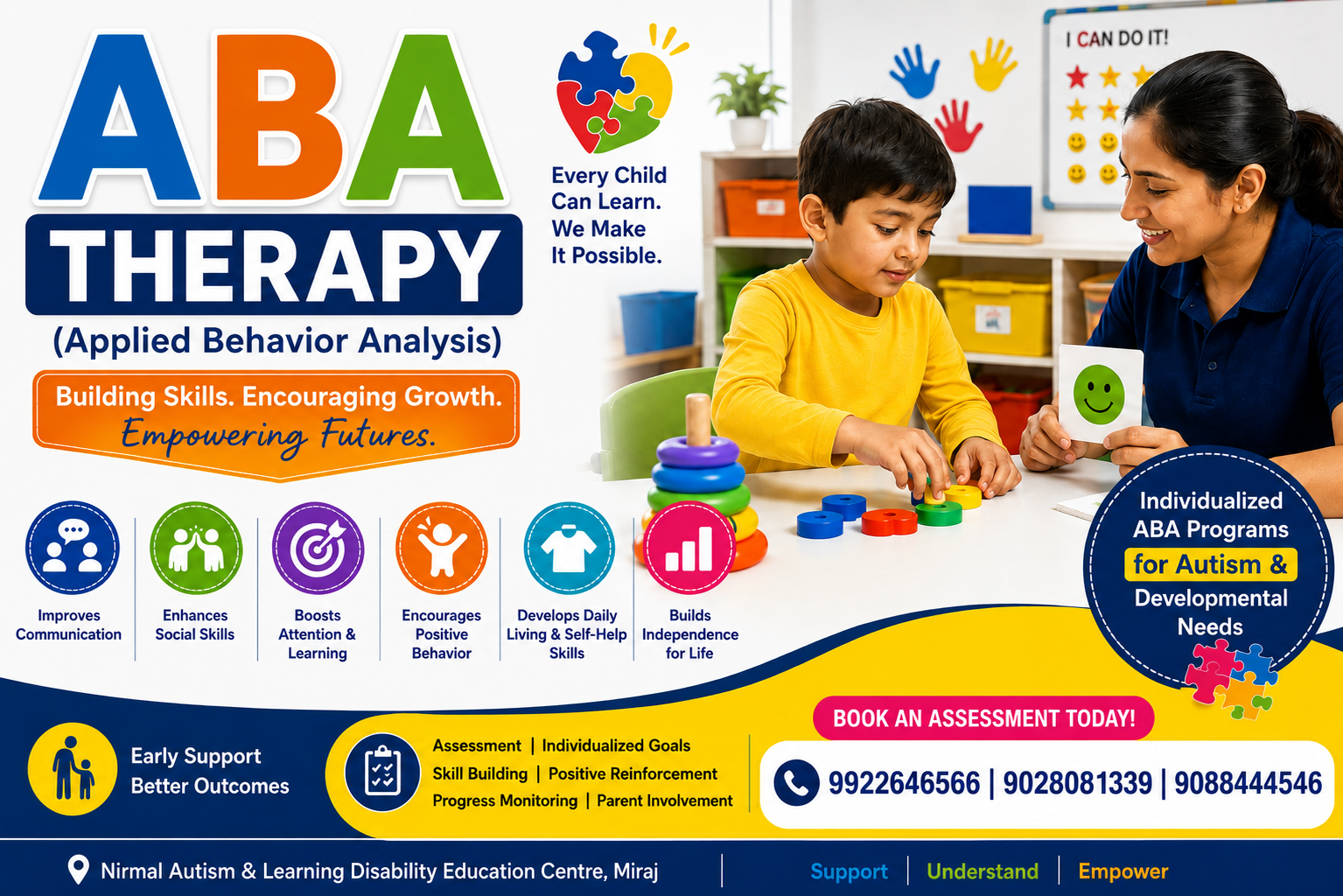
ABA Therapy (Applied Behavior Analysis) is an individualized, structured approach that uses principles of learning and behaviour to help children develop meaningful skills and reduce behaviours that interfere with learning or daily life.
ABA-based intervention may be considered for children with Autism Spectrum Disorder (ASD) and other developmental or behavioural needs. Programs can focus on communication, social interaction, learning, adaptive skills, self-care, participation and behavioural regulation.
The goals of therapy should be individualized around the child’s strengths, needs, preferences and everyday functioning.
What is ABA Therapy?
ABA stands for Applied Behavior Analysis.
ABA involves observing and understanding how behaviour occurs in different situations and using structured, evidence-informed teaching strategies to help children learn useful skills.
A therapist may break a complex skill into smaller steps, provide appropriate prompts and practice opportunities, and use positive reinforcement when the child demonstrates the desired response.
ABA-based programs can also include strategies to help children use newly learned skills across different people, places and situations.
How Does ABA Work?
ABA-based teaching may involve:
- Identifying the child’s current skills and needs
- Setting individualized and measurable goals
- Breaking skills into manageable steps
- Providing structured learning opportunities
- Using prompts when required
- Practising skills repeatedly
- Using positive reinforcement
- Monitoring progress
- Teaching skills across different environments
- Adjusting the program according to the child’s progress
Who Can Benefit from ABA-Based Intervention?
ABA-based intervention may be considered for children who need support with:
- Autism Spectrum Disorder (ASD)
- Functional communication
- Social interaction
- Attention and participation
- Learning skills
- Following instructions
- Daily living skills
- Self-care
- Behavioural regulation
- Emotional regulation
- Task completion
- Independence
- Challenging behaviours
A professional assessment helps determine which intervention approach is appropriate for an individual child.
What Skills Can Children Develop Through ABA Therapy?
1. Communication Skills
ABA-based teaching can support functional communication, including:
- Making requests
- Expressing needs
- Responding to questions
- Following instructions
- Initiating communication
- Using appropriate communication methods
- Improving functional language
For children who have limited verbal communication, appropriate communication supports may also be incorporated according to their individual needs.
2. Social Skills
Children may be supported in learning skills such as:
- Turn-taking
- Sharing
- Responding to others
- Initiating interaction
- Participating in group activities
- Following social routines
- Developing appropriate social responses
Social-communication interventions should be adapted to the child’s developmental level and delivered by appropriately trained professionals.
3. Behavioural Skills
Instead of simply trying to stop a behaviour, a behaviour-analytic approach looks at what may be happening before and after the behaviour.
The therapist may assess:
Antecedent → Behaviour → Consequence
This can help identify patterns and develop strategies that teach more functional ways for the child to communicate or respond.
Functional assessment is particularly important when challenging behaviour significantly affects the child’s learning, safety or daily participation.
4. Daily Living and Self-Help Skills
ABA-based teaching can support practical skills such as:
- Eating independently
- Dressing
- Brushing teeth
- Hand washing
- Toilet training
- Personal hygiene
- Following daily routines
- Organizing belongings
- Completing simple household tasks
The ultimate aim is to help children become more independent in everyday life.
5. Attention and Learning Skills
Therapy may focus on helping children:
- Attend to an activity
- Follow simple and complex instructions
- Sit and participate in age-appropriate activities
- Complete tasks
- Learn new concepts
- Transition between activities
- Develop learning readiness
- Generalize skills to everyday environments
6. Self-Regulation and Coping Skills
Children may be taught appropriate strategies to:
- Wait for their turn
- Handle changes in routine
- Communicate frustration
- Request a break
- Manage transitions
- Follow predictable routines
- Respond appropriately to everyday challenges
Positive Reinforcement in ABA Therapy
Positive reinforcement is commonly used in behaviour-analytic teaching.
When a child demonstrates a desired behaviour or successfully completes a learning task, an appropriate reinforcer may be provided to increase the likelihood that the behaviour will occur again.
Examples can include:
- Verbal praise
- Encouragement
- A preferred activity
- Access to a favourite toy
- Social interaction
- Other individualized reinforcers
Why is a Reward System Used?
Every child is different. Therefore, reinforcement should be selected according to the child’s:
- Interests
- Preferences
- Developmental level
- Motivation
- Learning goals
The purpose is to make learning meaningful and encourage useful skills rather than simply rewarding every behaviour.
How Does ABA Therapy Work?
A typical individualized ABA-based program may follow this process:
Assessment → Goal Setting → Skill Teaching → Practice → Reinforcement → Progress Monitoring → Program Review
Step 1 – Assessment
The child’s current abilities, strengths, challenges and functional needs are assessed.
Step 2 – Individualized Goal Setting
Specific and meaningful goals are identified according to the child’s developmental needs.
Step 3 – Skill Teaching
The therapist teaches targeted skills using appropriate teaching strategies, prompts and practice opportunities.
Step 4 – Positive Reinforcement
Appropriate reinforcement may be used to encourage desired skills and responses.
Step 5 – Progress Monitoring
Progress is monitored using appropriate data and observations.
Step 6 – Program Modification
The intervention plan can be modified according to the child’s response and changing needs.
Benefits of ABA-Based Intervention for Children
Individualized ABA-based intervention may support the development of:
- Functional communication
- Social participation
- Learning skills
- Attention and engagement
- Daily living skills
- Self-care
- Task completion
- Appropriate behavioural responses
- Self-regulation
- Independence
- Generalization of learned skills
The American Academy of Pediatrics describes behavioural interventions, including applied behaviour analysis, as approaches that can support skill development and adaptive behaviour in children with autism.
ABA Therapy for Autism
For children with Autism Spectrum Disorder, ABA-based strategies may be incorporated into a broader individualized developmental support program.
Depending on the child’s needs, the program may be combined with:
- Speech and Language Therapy
- Occupational Therapy
- Sensory Integration
- Play Therapy
- Remedial Education
- Special Education
- Social Skills Training
- Parent Training
A multidisciplinary approach can address different aspects of a child’s communication, learning, behaviour and daily functioning.
Why Individualized ABA Therapy Matters
Every Child Learns Differently
There is no single ABA program that is appropriate for every child.
An individualized program should consider:
- Age
- Developmental level
- Communication abilities
- Learning style
- Strengths
- Interests
- Sensory needs
- Behavioural needs
- Family priorities
- School and community requirements
Goals should be meaningful and focused on helping the child participate more effectively in everyday life.
Parent Involvement in ABA Therapy
Parents and caregivers can play an important role in supporting skill development outside therapy sessions.
Parent involvement may include learning:
- How to encourage communication
- How to provide appropriate prompts
- How to support daily routines
- How to reinforce useful skills
- How to respond to challenging behaviour
- How to create learning opportunities at home
Consistency between therapy, home and other environments can help children practise and generalize skills. NICE guidance also emphasizes collaboration with parents, carers and professionals when implementing interventions.
ABA Therapy and Generalization of Skills
Learning a skill during therapy is only one part of the process.
Children may also need support to use the skill:
- At home
- At school
- With parents
- With teachers
- With siblings
- With peers
- In community settings
For example, a child who learns to request an item during therapy should gradually be supported to use that communication skill in everyday situations.
ABA Therapy for Challenging Behaviour
Some children may display behaviours that interfere with learning or daily activities.
Examples may include:
- Frequent tantrums
- Aggressive behaviour
- Self-injurious behaviour
- Property destruction
- Running away
- Refusal to participate
- Difficulty with transitions
A professional behaviour assessment can help identify possible triggers, patterns and functions of behaviour.
Intervention should focus on improving quality of life and teaching functional alternatives rather than relying only on punishment or suppression of behaviour. NICE recommends functional assessment and individualized psychosocial intervention when challenging behaviour requires intervention.
Is ABA Therapy Evidence-Based?
ABA refers to a scientific discipline that applies principles of learning and behaviour to socially meaningful goals.
Research and clinical guidance have supported behaviour-based approaches for developing skills and addressing some behavioural needs in children with autism. However, the quality and effectiveness of individual programs can vary, and intervention should be individualized, ethically delivered and regularly evaluated.
The goal should be to improve meaningful skills, communication, participation, independence and quality of life—not to make every child behave in exactly the same way.
Frequently Asked Questions About ABA Therapy
1. What does ABA stand for?
ABA stands for Applied Behavior Analysis.
2. Is ABA Therapy only for children with autism?
No. Behaviour-analytic principles can be applied to different developmental, learning and behavioural needs. A professional assessment can help determine whether an ABA-based approach is appropriate for a particular child.
3. Does ABA Therapy cure Autism?
No. ABA does not cure autism. Autism is a neurodevelopmental condition. ABA-based intervention focuses on developing functional skills, communication, independence, participation and adaptive behaviours.
4. At what age can ABA Therapy begin?
ABA-based intervention can be considered across childhood. Goals, teaching strategies and expectations should be adapted to the child’s age, developmental level and individual needs.
5. How long does ABA Therapy take?
There is no fixed duration that applies to every child. Frequency and duration depend on the child’s goals, needs, response to intervention and progress.
6. Does every child need intensive ABA therapy?
No. The intensity and type of intervention should be individualized. A qualified professional should assess the child’s needs and recommend an appropriate intervention plan.
7. Can ABA Therapy be combined with other therapies?
Yes. Depending on the child’s needs, ABA-based intervention may be incorporated into a broader developmental program that can include speech therapy, occupational therapy, special education, sensory-based interventions, play-based approaches and parent training.
8. Is parental involvement important in ABA?
Yes. Parents can help children practise functional skills in everyday environments and can learn strategies that support communication, learning and positive behaviour.
9. Does ABA only focus on reducing unwanted behaviour?
No. A well-designed program can focus on teaching new and meaningful skills, including communication, social interaction, learning, self-care, independence and functional participation.
10. ABA Therapy at Nirmal Autism & Learning Disability Education Centre, Miraj
At Nirmal Autism & Learning Disability Education Centre, Miraj, therapy programs are planned according to the individual developmental and learning needs of each child.
Depending on the assessment, an individualized program may focus on:
- Communication
- Social interaction
- Behavioural skills
- Attention
- Learning
- Daily living skills
- Self-care
- Self-regulation
- Task participation
- Independence
ABA-based intervention may also be integrated with other developmental therapies when appropriate.
Our approach focuses on individualized goals, meaningful skill development, parent involvement and regular progress review.
When Should Parents Seek a Developmental Assessment?
Parents may consider professional assessment if they notice concerns such as:
- Delayed speech or communication
- Limited social interaction
- Repetitive behaviours
- Difficulty following instructions
- Poor attention
- Difficulty learning age-appropriate skills
- Frequent challenging behaviours
- Difficulty with daily living activities
- Difficulty adapting to changes
- Delayed developmental milestones
Early identification can help families understand the child’s strengths and needs and explore appropriate support.
Give Your Child the Right Support for Their Development
Every child has unique strengths and learning needs.
The goal of therapy is to help children develop functional skills, communication, independence and participation in everyday life through an individualized and supportive approach.
If you are concerned about your child’s communication, behaviour, learning or development, a professional assessment can help guide the next steps.