Learn about rTMS therapy for children with autism and ADHD, its procedure, potential benefits, safety and specialist assessment at Nirmal Autism Centre, Miraj.
rTMS is a non-invasive brain stimulation technique being studied for selected neurodevelopmental symptoms. Learn about the procedure, safety and specialist assessment for children.
What is rTMS Therapy?
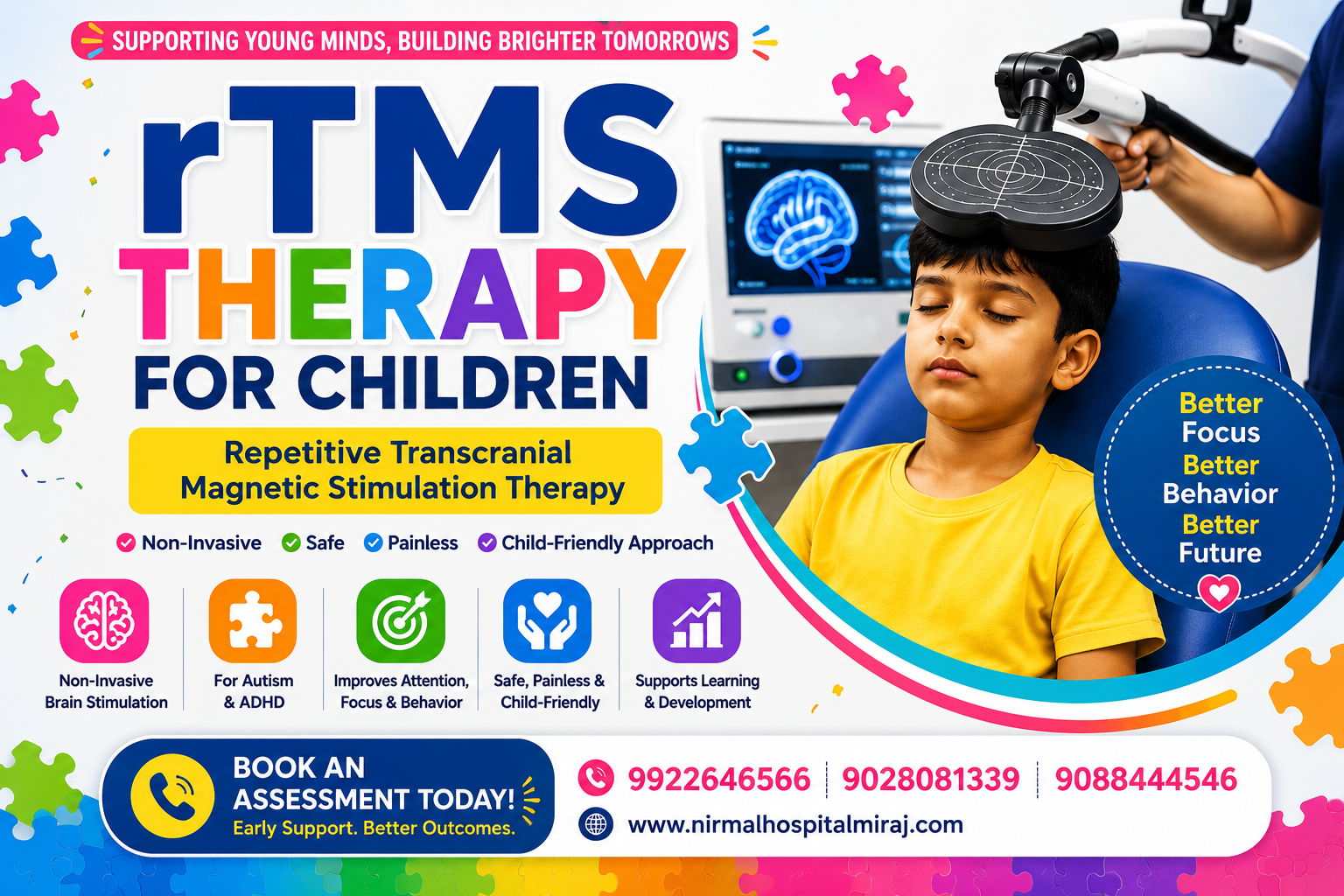
Repetitive Transcranial Magnetic Stimulation (rTMS) is a non-invasive brain stimulation technique that uses controlled magnetic pulses to stimulate specific areas of the brain.
During Repetitive Transcranial Magnetic Stimulation, a magnetic coil is positioned near the child’s scalp. The device delivers brief magnetic pulses that can influence activity in targeted brain regions.
rTMS has been investigated as a potential adjunctive approach for certain symptoms associated with neurodevelopmental conditions, including Autism Spectrum Disorder (ASD) and Attention-Deficit/Hyperactivity Disorder (ADHD).
However, research regarding rTMS for autism and ADHD in children is still developing. Therefore, rTMS should not be considered a replacement for established developmental, behavioural, educational or therapeutic interventions.
rTMS Therapy for Autism in Children
Autism Spectrum Disorder is a neurodevelopmental condition that can affect social communication, interaction, behaviour, sensory processing and patterns of interests or activities.
Research has explored whether Repetitive Transcranial Magnetic Stimulation may influence selected symptom domains such as:
- Repetitive or stereotyped behaviours
- Social interaction
- Attention and executive functions
- Certain aspects of behavioural regulation
Current evidence remains preliminary, and studies have used different stimulation targets, frequencies and treatment schedules. Therefore, the suitability of Repetitive Transcranial Magnetic Stimulation must be assessed individually by a qualified medical professional.
Important: rTMS does not “cure” autism. Autism support should continue to include evidence-based developmental and educational interventions according to the child’s individual needs.
rTMS and ADHD in Children
ADHD can involve difficulties with attention, impulse control, hyperactivity and executive functioning.
Repetitive Transcranial Magnetic Stimulation and other non-invasive brain stimulation techniques are being studied for ADHD. Research has explored stimulation of brain regions involved in attention and executive functioning. However, evidence regarding the clinical effectiveness of rTMS for ADHD remains inconclusive, particularly when considering children and adolescents.
For children with ADHD, treatment planning should be individualized and may involve behavioural interventions, parent training, educational support, psychological interventions and medication when clinically indicated.
How Does rTMS Work?
Repetitive Transcranial Magnetic Stimulation uses a specially designed magnetic coil to deliver magnetic pulses through the scalp.
These pulses can influence neuronal activity in the targeted brain region. Depending on the stimulation protocol, clinicians may aim to modulate activity in brain networks involved in attention, executive functioning, social behaviour or behavioural regulation.
The exact stimulation target and protocol are determined by the treating specialist based on the child’s clinical assessment.
What Happens During an rTMS Session?
A typical Repetitive Transcranial Magnetic Stimulation session may involve:
1. Clinical Assessment
The child’s developmental, behavioural and clinical history is reviewed before considering Repetitive Transcranial Magnetic Stimulation.
2. Treatment Planning
The treating specialist determines whether Repetitive Transcranial Magnetic Stimulation is appropriate and identifies the treatment protocol.
3. Positioning
The child is comfortably seated and the magnetic coil is positioned over the selected area of the scalp.
4. Magnetic Stimulation
The device delivers a series of controlled magnetic pulses.
5. Monitoring
The child is observed during the session for comfort and any possible side effects.
6. Follow-Up
The child’s response is reviewed regularly and the treatment plan is modified when clinically necessary.
How Long Does an rTMS Session Take?
The duration of an Repetitive Transcranial Magnetic Stimulation session can vary depending on the stimulation protocol and the child’s individual treatment plan.
In clinical settings, sessions may commonly last several minutes to around 20–40 minutes, but the exact duration should be determined by the treating specialist.
The number and frequency of sessions also vary according to the clinical indication and protocol.
Potential Areas Being Studied in Autism
Research on Repetitive Transcranial Magnetic Stimulation in autism has investigated possible effects on selected areas such as:
- Social interaction
- Repetitive and stereotyped behaviours
- Executive functioning
- Attention
- Behavioural regulation
Some studies have reported potential improvements in selected symptom domains, but the evidence is not yet strong enough to establish Repetitive Transcranial Magnetic Stimulation as a standard treatment for autism. Differences between studies in stimulation parameters and study design make it difficult to determine the most effective protocol.
rTMS for Children: Is It Safe?
Repetitive Transcranial Magnetic Stimulation is generally considered a non-invasive neuromodulation technique. Studies in neurodevelopmental conditions have generally reported no severe adverse effects, but side effects can occur.
Reported side effects may include:
- Headache
- Scalp discomfort
- Facial discomfort or twitching
- Irritability
- Dizziness in some cases
A systematic review of Repetitive Transcranial Magnetic Stimulation in autism reported headache, facial discomfort and irritability among the commonly reported adverse effects.
Because children and adolescents require special consideration, treatment should only be considered after appropriate clinical assessment and under qualified professional supervision.
Who May Be Considered for rTMS?
Repetitive Transcranial Magnetic Stimulation is not suitable for every child.
A specialist may consider factors such as:
- The child’s age and developmental level
- Diagnosis and presenting symptoms
- Behavioural and cognitive profile
- Existing therapies
- Medical history
- Previous treatment response
- Ability to cooperate during the procedure
- Presence of relevant medical contraindications
- Parent/guardian understanding and consent
A detailed assessment should be completed before starting any neuromodulation treatment.
rTMS Is Not a Replacement for Autism Therapy
For children with autism, comprehensive intervention remains important.
Depending on the child’s needs, the treatment and educational plan may include:
- ABA-based interventions where appropriate
- Special education
- Speech and language therapy
- Occupational therapy
- Sensory integration therapy
- Remedial education
- Behavioural intervention
- Parent training
- Social skills training
- Psychological support
Indian pediatric consensus recommendations emphasize early, structured and evidence-based interventions tailored to the developmental needs of each child.
rTMS Therapy at Nirmal Autism & Learning Disability Education Centre
At Nirmal Autism & Learning Disability Education Centre, Miraj, children are assessed according to their individual developmental, behavioural, educational and clinical needs.
Our multidisciplinary approach may include assessment and appropriate developmental interventions such as:
- Special education
- Remedial therapy
- Behavioural interventions
- Sensory integration
- Play-based activities
- Parent guidance
- Developmental support
WhereRepetitive Transcranial Magnetic Stimulation is being considered, the child’s suitability should first be evaluated by the treating medical professional.
The goal is not simply to provide a procedure, but to develop an individualized care plan based on the child’s needs.
Frequently Asked Questions About rTMS for Children
1. Is Repetitive Transcranial Magnetic Stimulation a treatment for autism?
rTMS is being studied as a potential adjunctive approach for selected autism-related symptoms. Current evidence is still preliminary, and rTMS is not established as a cure or routine treatment for autism.
2. Can Repetitive Transcranial Magnetic Stimulation cure autism?
No. There is currently no evidence that rTMS cures Autism Spectrum Disorder. Autism management focuses on individualized developmental, behavioural, educational and therapeutic support.
3. Is Repetitive Transcranial Magnetic Stimulation suitable for every child with autism?
No. Suitability depends on the child’s age, clinical condition, developmental profile, medical history and ability to cooperate with the procedure. A specialist assessment is necessary.
4. Can Repetitive Transcranial Magnetic Stimulation help children with ADHD?
rTMS is being researched for ADHD and some studies suggest possible effects on attention and related symptoms. However, current evidence remains inconclusive, particularly for routine use in children.
5. Does Repetitive Transcranial Magnetic Stimulation hurt?
rTMS is non-invasive. Some people may experience scalp discomfort, headache, facial muscle sensations or other temporary discomfort during or after treatment.
6. How many Repetitive Transcranial Magnetic Stimulation sessions does a child need?
There is no single session schedule that applies to every child. The number, frequency and duration of sessions depend on the clinical indication and the protocol selected by the treating specialist.
7. Does the child need to be admitted to hospital?
rTMS is generally performed as a supervised treatment session rather than requiring routine hospital admission. The treating team will decide the appropriate setting based on the child’s clinical needs.
8. Can Repetitive Transcranial Magnetic Stimulation be combined with other autism therapies?
If clinically appropriate, rTMS may be considered alongside a child’s existing developmental and educational interventions. It should not automatically replace established therapies.
9. Why Choose a Child-Centred Approach?
Every child has different strengths, challenges and developmental needs.
At Nirmal Autism & Learning Disability Education Centre, the focus is on understanding the individual child rather than using a one-size-fits-all approach.
Our approach aims to support:
- Communication
- Attention
- Learning
- Social interaction
- Behavioural development
- Functional skills
- Parent participation
- Overall developmental progress
10. When Should Parents Seek Professional Guidance?
Parents may consider a developmental assessment if they notice concerns related to:
- Delayed speech or communication
- Difficulty interacting with others
- Repetitive behaviours
- Poor attention
- Hyperactivity or impulsivity
- Learning difficulties
- Sensory sensitivities
- Difficulty following instructions
- Delayed developmental milestones
- Behavioural difficulties
Early assessment can help identify the child’s needs and guide appropriate intervention.